
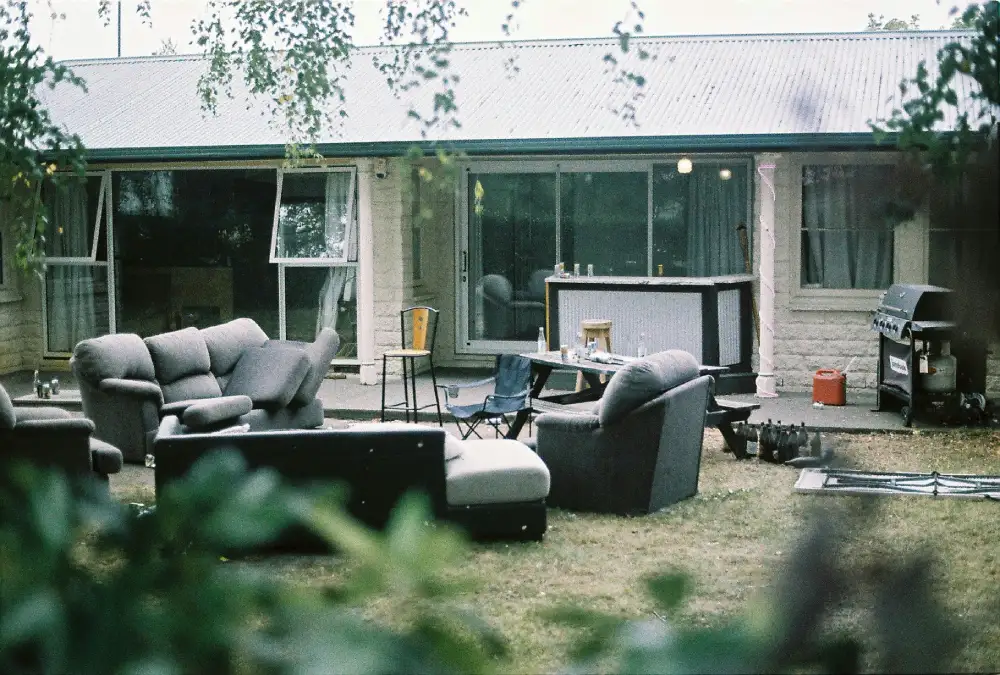
A sagging sofa, a broken dresser, or a worn mattress will not fit in a regular trash can. Old furniture removal follows a separate process. Cities group these items under labels like bulky items, bulk trash, or heavy trash, each setting its own rules for when items go out, how many pieces are allowed, and what gets turned away.
This guide explains how those city programs work, using the published rules of four large programs: New York City, Los Angeles, Houston, and Phoenix. It covers what qualifies, how to get on the schedule, how to prepare a couch or mattress for the curb, why refrigerators follow different rules, and where furniture goes after pickup
What Cities Count as Bulky Items
The term is broad. It means household items too large or heavy for a standard cart. Los Angeles lists furniture like couches, tables, and chairs, along with mattresses, box springs, toilets, sinks, rolled and tied carpet, large wood pieces or doors, and electronic waste such as TVs and monitors. Houston’s heavy trash collection takes household furniture, carpet, mattresses, box springs, tree limbs within size limits, and up to four passenger tires.
What gets refused varies as much. Los Angeles excludes construction materials, automotive parts, used oil, paints, solvents, medicines, needles, fluorescent lights, and commercial appliances. Houston turns away electronics, household hazardous waste, dirt, sod, roofing shingles, and contractor debris. Phoenix refuses tires, glass, concrete, bricks, roofing materials, and large appliances containing refrigerant.
The lists do not align. A television goes curbside in Los Angeles but not in Houston. Tires go curbside in Houston but not in Phoenix. That is why the first step in any search for “big items pickup” is the city’s sanitation page, not a general list.
How Bulk Pickup Works
City programs fall into two broad models, and the difference changes how a household plans.
Scheduled Collection vs. On-Call Appointments
Under a set schedule, old furniture removal follows the city’s calendar: the city comes on fixed dates and residents put items out within a window. Houston collects heavy trash every other month, allowing up to six curbside collections per year at eligible addresses. Items go out between 6:00 p.m. the Friday before and 7:00 a.m. on collection day.
Under an appointment model, nothing goes to the curb until the resident books a slot. Phoenix handles bulk pickup by appointment only, booked online or by phone, with four collection opportunities per household each year. Items cannot go out more than seven days before the appointment and must be in place by 5:30 a.m. on collection day. Los Angeles asks residents to request large item pickup at least one business day before their normal collection day, through the MyLA311 app, the city’s online service request form, or its 24-hour phone line.
New York City sits apart. The Department of Sanitation no longer takes pickup appointments for most large items. Residents set large items at the curb without an appointment, up to six items per collection day: metal and rigid plastic pieces go out with recycling, and wood, upholstered, and other non-recyclable furniture goes out on trash-only days. For any household, the model the city uses decides whether the next step is a phone call or simply checking the calendar.
Item Limits and Fees
Each program caps volume differently. Phoenix allows up to 10 cubic yards per residence. Houston sets a maximum of 8 cubic yards per set-out, comparing it to the size of a minivan, and caps building materials at 4 cubic yards. Los Angeles describes its curbside bulky item service as unlimited, at no additional charge, asking residents to describe items when booking so the right truck is sent. New York City offers free curbside removal for furniture, mattresses, and rugs.
None of the four programs reviewed here lists a separate per-item fee for standard household furniture on the pages consulted. Fees in other cities were not checked and should be confirmed locally.
Who Is Covered: Houses vs. Apartments
In some cities, service stops at a certain building size, which matters to renters planning old furniture removal. Los Angeles limits bulky item service to single-family residents, meaning homes of one to four units serviced by the city. Houston excludes multi-residential buildings with more than eight units. Residents of larger buildings in those cities are outside the bulk trash removal program and should ask building management how large items are handled before setting anything out.
Zhanjiang Chen on Unsplash
How Much Can Go Out at Once
New York City allows up to six large items at the curb per collection day. Houston caps each heavy trash set-out at 8 cubic yards, about the size of a minivan.
Preparing Furniture for Curbside Collection
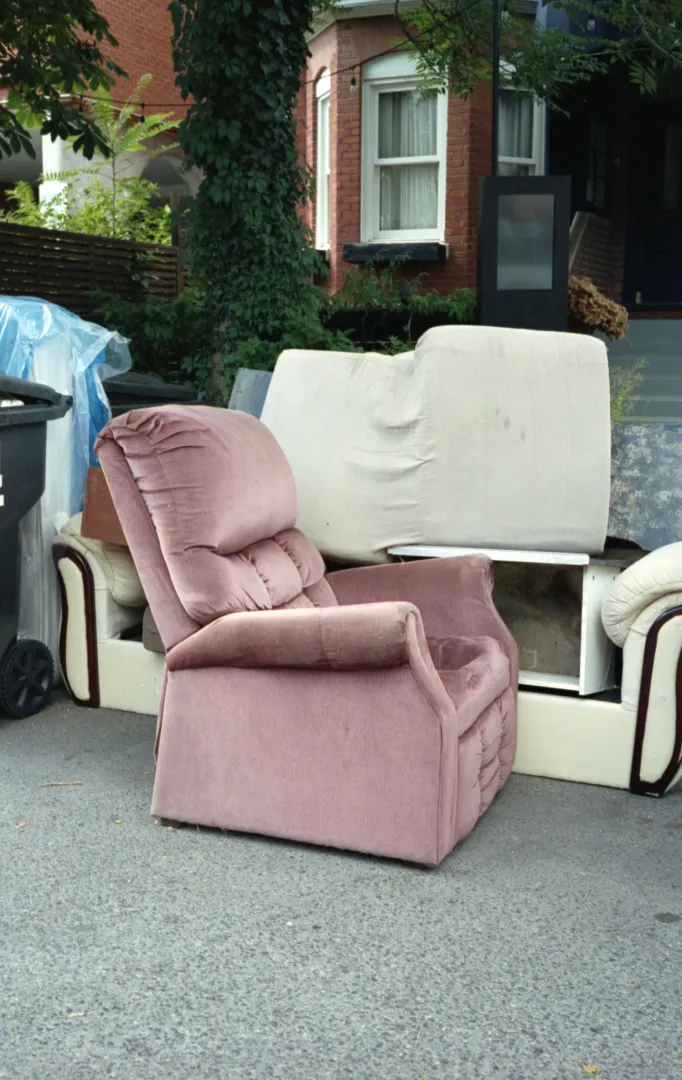
Timing and placement rules are specific, and each city spells them out. Houston asks for items just behind the curb line in front of the home, not in the street or on the sidewalk, and not stacked under wires, signs, or mailboxes, or on meters. Phoenix wants a single pile at the edge of the property, parallel to the street, no more than 5 feet from the street or curb, and at least 5 feet from fixed objects. In New York City, buildings with one to nine units set trash out after 6:00 p.m., and all waste should be out by midnight unless otherwise specified.
A little preparation makes pickup smoother. Clear drawers and cushions, keep the pile compact, and keep it off any spot the city lists as off-limits.
Mattresses and Box Springs
Mattresses get their own rules in several places. New York City requires every mattress or box spring set out for collection to be fully contained in a clear plastic bag that is securely sealed, to prevent the spread of bed bugs. The Department of Sanitation warns that a mattress or box spring that is not disposed of correctly can lead to a fine.
The Mattress Recycling Council, a nonprofit formed by the mattress industry, runs state-mandated recycling programs in California, Connecticut, Oregon, and Rhode Island under the consumer name “Bye Bye Mattress.” By 2022, the council’s programs, then running in California, Connecticut, and Rhode Island, had recycled 10 million mattresses. Oregon’s program followed in 2025.
Furniture With Bed Bugs
Throwing furniture out is not always the right answer to an infestation. The New York City Department of Health notes that most of the time, clothing, bedding, and furniture from a home with a bed bug problem can be treated and do not need to be thrown away, and recommends a professional inspection first.
When a piece must go, old furniture removal takes extra care. The guidance says to wrap it in heavy-duty plastic sealed with duct tape and to do the wrapping in the room where the item was kept so bugs do not spread. It also says to cut or deface the item so no one takes it home, attach a sign reading “BED BUG INFESTED - DO NOT TAKE,” and set it out close to collection time. Items from an infested home should never be donated.
Fridge Pick Up and Other Appliances
Refrigerators, freezers, and air conditioners do not move like a sofa because of what is inside them. Under Section 608 of the Clean Air Act, federal rules at 40 CFR 82.155 require the refrigerant in small appliances such as refrigerators and window air conditioners to be recovered before disposal. The final processor in the disposal chain, such as a scrap recycler or landfill, must either recover any remaining refrigerant or verify through a signed statement or a contract that it was already recovered. The statement has to give the name and address of the person who recovered the refrigerant and the date.
That rule shapes how a fridge pick up works at the city level:
- New York City offers free refrigerant removal by appointment through 311, for up to 10 appliances per appointment. Residents must remove hinges and locks from refrigerators and freezers as a child and animal safety measure, then set the appliance at the curb after 6:00 p.m. the night before, back facing the street. Staff recover the refrigerant and attach a tag with a six-digit number. Only tagged appliances are collected. The city states that newer units using R600a or R32 refrigerant cannot be collected through this service.
- Houston collects refrigerators and freezers with heavy trash only if they carry a certified technician’s tag showing the refrigerant has been removed.
- Phoenix does not take large appliances with refrigerants in bulk trash at all.
The EPA also runs the Responsible Appliance Disposal program, a voluntary partnership launched in 2006 with utilities, retailers, manufacturers, state and local agencies, and others. Partners commit to complying with laws on recovering refrigerant, used oil, and PCBs, recovering appliance foam, promoting the recycling of durable goods, and promoting the permanent retirement of old, inefficient appliances to save energy.
How to Get Rid of a Couch or Sofa
The couch is one of the most common pieces in old furniture removal, and one of the hardest to handle alone because of its size and weight. Anyone wondering how to get rid of a sofa has the same basic options as for any other furniture, applied to a bigger object.
The first route is the city program. Los Angeles lists couches among accepted bulky items, Houston takes household furniture with heavy trash, and New York City accepts furniture at the curb, with wood and upholstered pieces going out on trash-only days. For most households, that is the simplest answer to how to dispose of a couch, as long as the set-out rules above are followed.
The second route is a drop-off. Los Angeles holds free monthly bulky item drop-off events on Saturdays at five locations around the city, and LA Sanitation posts current dates and accepted items. Residents who can borrow a truck may find it easier to get rid of couch pieces this way than to wait for the next collection window.
The third route is reuse. A sofa in good shape does not have to go to the landfill, a point covered in the next section.
A few practical points apply no matter which route is chosen. Anyone figuring out how to dispose of old couch frames or how to get rid of couches after a move should measure doorways and stairwells before carrying anything out and plan for at least two people. Anyone researching how to dispose of a sofa that is torn, stained, or exposed to pests should plan on the city program, since Habitat for Humanity ReStores do not accept upholstery with tears, stains, or pet damage. If the piece is unusually large, such as a sectional, it is worth confirming the city’s size limits first.
Curbside pickup only works when the set-out rules are followed. For anyone working out how to throw away a couch without a fine, the safest order is to check what the city accepts, confirm the schedule or book the appointment, and place the piece exactly where the city asks. The same steps answer how to dispose of old sofa sets, sectionals, and loveseats.
Donation, Resale and Drop-Off Sites
Before calling the city, ask whether the piece has another life. Habitat for Humanity, a nonprofit, states that most of its ReStore locations offer furniture pickup, along with pickup for appliances and building materials. Commonly donated items include sofas, chairs, dining tables, dressers, bed frames, coffee tables, end tables, filing cabinets, and bookshelves. Upholstered or leather furniture must be free of tears, stains, and pet damage. Accepted items differ by store, so the local ReStore is the one to call.
Resale is another path. A table or dresser in usable condition can be sold or given away locally. For someone who wants to get rid of sofa sets that are still in good shape, donation or resale is often the quickest way out the door.
Drop-off sites are the last option before the curb. Some cities run transfer stations or special collection events, like the Los Angeles drop-off events described above. Hours and residency rules vary. Choosing reuse over disposal is the part of old furniture removal that has the most effect on what ends up in a landfill.
When a cleanout goes beyond a few pieces, such as an estate cleanout or a full move, city limits may not be enough. In that case, a rented container may make more sense.
Where Old Furniture Ends Up
The national numbers show why reuse matters. According to the EPA, furniture and furnishings, including sofas, tables, chairs, and mattresses, made up 12.1 million tons of municipal solid waste in 2018, or 4.1 percent of the total. Of that, 9.68 million tons, or 80.1 percent, went to landfills, and 2.36 million tons, or 19.5 percent, were burned for energy recovery. The EPA notes no measurable recycling data was available for the category, except for mattresses.
The same data show wood is the largest material in furniture, followed by ferrous metals, with plastics, glass, and textiles also present. In other words, roughly four out of five tons of discarded furniture were buried, and most of the rest was burned. The full breakdown is in the EPA’s durable goods data.
Frequently Asked Questions
How do you get rid of a couch if your city has no bulk pickup?
Start with the city or county sanitation page, as some places offer drop-off events or transfer stations instead of curbside service. If the couch is in good condition, donation pickup is another option. For anyone asking how do you get rid of a couch in a building the city does not serve, building management is the first call.
How do I get rid of an old sofa for free?
City programs are the main no-cost option. New York City describes its curbside furniture removal as free, Los Angeles offers curbside pickup at no additional charge, and also holds free monthly drop-off events. Donating to a nonprofit that offers pickup is free if the sofa meets condition rules. Anyone asking how to get rid of an old sofa at no cost should check both routes, since how to get rid of an old sofa cheaply depends on its condition.
Is bulk trash removal the same as junk removal?
Not quite. Bulk trash removal usually refers to city service, with set rules on what is accepted and when. Junk removal usually refers to a private hauler hired directly, which sets its own prices and rules on what it takes.
Can you leave furniture at the curb without scheduling?
It depends on the city. In Phoenix, items cannot go out until an appointment is booked. In Los Angeles, the city must be notified at least one business day before collection. In New York City, furniture can go out at the curb without an appointment, sorted into trash or recycling by material, but refrigerant appliances still need one. Setting items out outside the rules can lead to a fine, so check the program before setting anything out.
The Bottom Line
In the four cities reviewed, bulky item programs take most household furniture with no separate per-item charge listed, but each city sets its own schedule, limits, and refused-item list. Mattresses, bed bug infested items, and refrigerated appliances have extra rules. Before calling for pickup, check whether the piece can be donated, then follow the city’s set-out rules exactly. That is the simplest path to old furniture removal without a fine or rejected pickup.(you can see)