
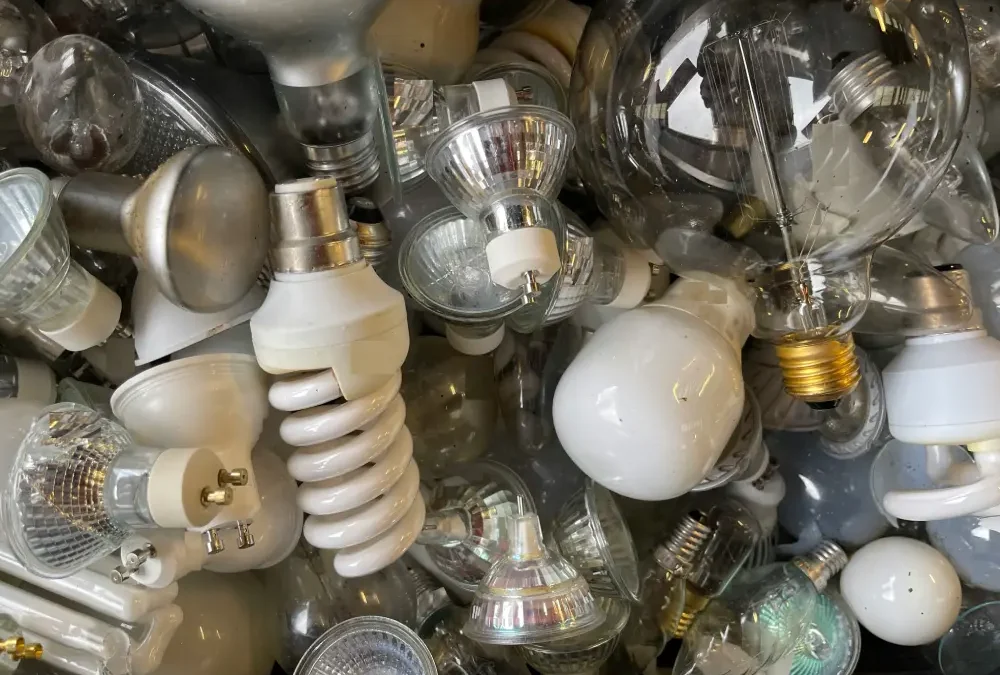
Photo by John Cameron on Unsplash (modified)
Table of Contents
A hardware store on the way home is the easiest place to imagine dropping off a dead bulb. It is also where most of these trips fail, because the chains that name a bulb name only one kind, and it is not the four-foot tube.
Three retailers come up most often in this question. Two of them describe a bulb program. The third does not run one at all. And the only bulb either program names in writing is the compact fluorescent, which accounted for under a tenth by weight of the lamps collected last year by the one statewide program examined below.
In at least one state, Washington, lamp collection is organized under state law and retailers are among the collectors. Elsewhere, a store bin is whatever the company chooses to run, for as long as it chooses to run it. What follows is what each company publishes about its own program, and what that leaves you holding.
What Home Depot Publishes About Bulbs
Home Depot disposal of fluorescent bulbs is described on the company's own guidance page, and the description is narrower than most people expect.
The page names the company as a drop-off point for one category only: "There are several retailers who accept intact and undamaged CFL bulbs for recycling, including The Home Depot." Two conditions sit inside that sentence. The bulb has to be a compact fluorescent, and it has to be unbroken. A cracked spiral does not qualify, which is why CFL recycle Home Depot searches that start after a bulb has shattered end somewhere else entirely.
For straight tubes, the page names no acceptance of its own. It describes them as hazardous waste, states that "It's illegal to throw them in regular trash or put them out on the curb for collection," and then points outward rather than inward: "some local recycling programs have special recycling protocols for these tubes." The closing line sends you to the store for everything else — "Stop by your local The Home Depot to find out the most up-to-date recycling information for your region and in-store options for recycling light bulbs, batteries and other spent electronics" — and that sentence says "light bulbs" without naming a single type. So anyone searching recycle fluorescent tubes home depot, or home depot recycle fluorescent tubes, or home depot recycling fluorescent tubes is asking something the page answers by sending them somewhere else, or to the store itself. Fluorescent light disposal Home Depot names, in writing, the screw-in spiral and not the four-foot tube.
The same page handles the other bulb types in two sentences each. Incandescent bulbs are the easiest to deal with and can go in household trash, though the glass and metal are hard to recover and some local recycling centers may still take them. Halogen bulbs can also go in household trash and pose little environmental threat, but they are difficult to recycle. So a search for recycle incandescent light bulbs home depot is answered, just not the way the searcher hoped: the answer is the trash can, not the store. LED bulbs sit between the two, with trace lead and arsenic, and some communities collect them separately.
Home depot disposal of fluorescent bulbs also comes with a standing caveat the company repeats twice. "Check with your local The Home Depot store and other retailers about their on-site recycling options," it says, and separately, "Some cities and states have made it illegal to put bulbs that contain mercury into the regular trash, so check first." Both sentences push the real answer back to your store and your state. A home depot light bulb disposal bin in one city is not evidence of one in the next, which is why home depot cfl disposal, home depot compact fluorescent recycling and home depot fluorescent light recycling can each be true in one parking lot and false in another.
The practical reading: fluorescent bulb recycling home depot names, in the company's own words, intact CFLs only. Fluorescent light bulb disposal home depot, for a tube, is not something the page offers in its own aisles. Recycle light bulbs home depot, home depot recycle light bulbs and home depot recycling light bulbs all narrow to the same single named category once you read the page rather than the search box — and to a phone call for anything else.
If your bulb is broken, none of this applies and the cleanup comes first.
What Lowe's Publishes, and When
Lowe's has described the same shape of program for longer, and its most recent public description is now several years old.
The company announced in-store recycling centers in September 2010, in nearly 1,700 stores, taking rechargeable batteries, cell phones, CFLs and plastic shopping bags. Its corporate newsroom restated the list in an article dated November 15, 2019: the recycling center "accepts plastic bags, CFL bulbs, rechargeable batteries, and cellphones," and "CFL lightbulbs can be recycled at a Lowe's recycling center." The garden center takes plastic planter pots and cases separately. Alkaline batteries, the page notes, are not recyclable and belong in the trash.
Fluorescent tubes appear in neither description. So the answer to does Lowe's recycle fluorescent bulbs is a qualified yes for compact fluorescents, and the answer to does Lowe's recycle fluorescent tubes is that neither of those two publications mentions them. Does Lowe's recycle fluorescent tube bulbs lands in the same gap. What Home Depot disposal of fluorescent bulbs names and what Lowe's names turn out to be the same narrow category, arrived at independently.
That leaves the date problem. The newsroom description is from November 2019, and a bin described nearly seven years ago is not a bin confirmed today. Can I recycle fluorescent bulbs at Lowe's is therefore a question for the specific store, by phone, before loading the car. The same goes for Lowe's light bulb recycling, Lowe's fluorescent light bulb recycling and Lowe's fluorescent light bulbs recycling as search phrases: they describe a program that was published, not one that has been reconfirmed.
For tubes specifically, neither description covers them. Recycle fluorescent tubes Lowe's, Lowe's recycle fluorescent tubes, Lowe's fluorescent tube recycling and Lowe's fluorescent tube disposal all point at something the two published descriptions do not address. Dispose of fluorescent tubes Lowe's, fluorescent light disposal Lowe's, fluorescent bulb disposal Lowe's and Lowe's fluorescent bulb disposal reach the same wall. Light bulb disposal Lowe's, recycle light bulbs at Lowe's and Lowe's recycle light bulbs are accurate only for the compact kind, and only if the local store still runs the bin. Lowe's recycle fluorescent bulbs, in short, means CFLs.
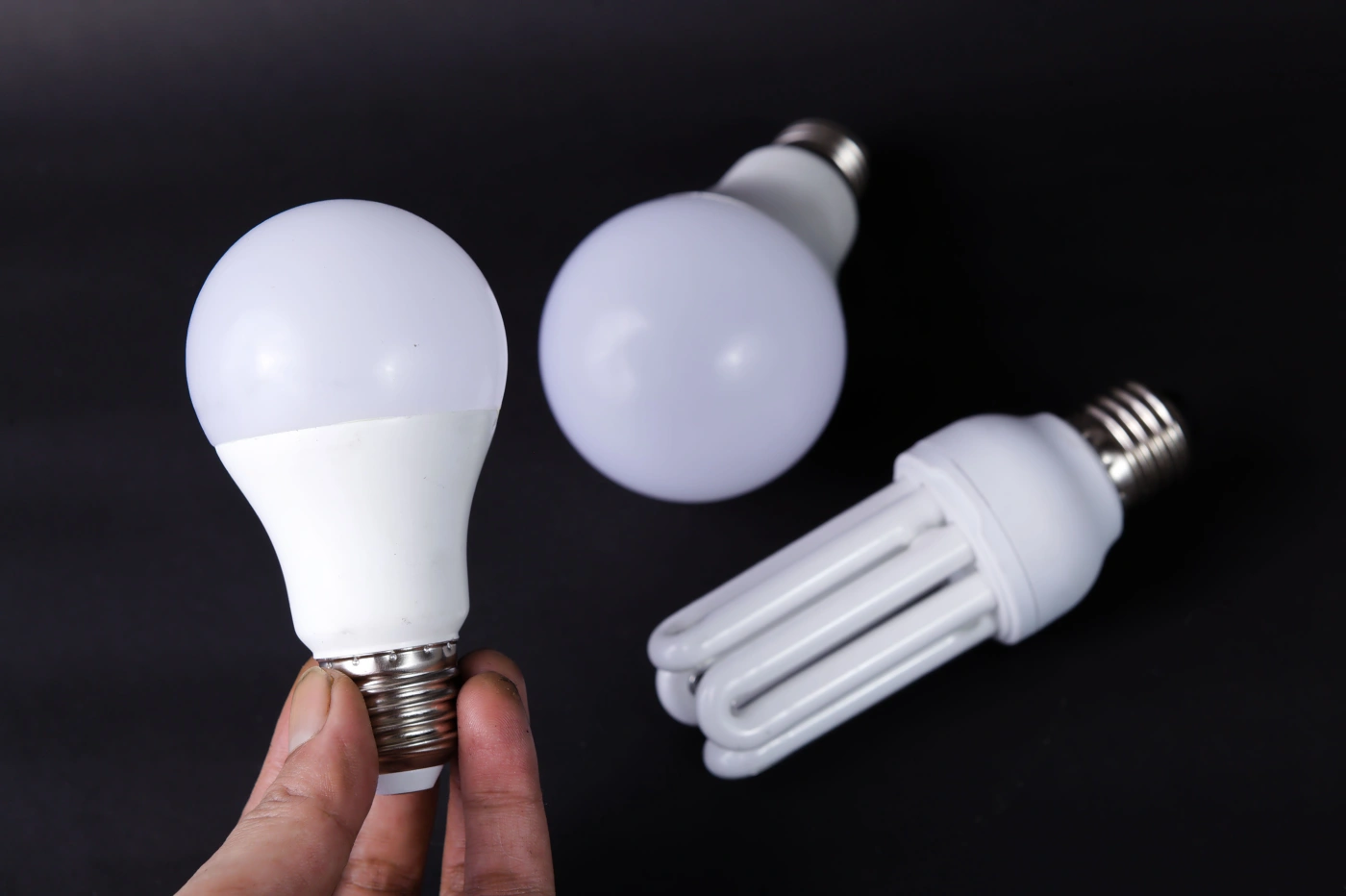
Photo by John Cameron on Unsplash (modified)
Compact fluorescents, incandescents, and halogens sit in the same drawer at home — but only one of them contains mercury, and only one of them is what Home Depot’s own page names as accepted.
Why Staples Comes Up at All
Staples comes up constantly in bulb recycling searches, and none of it should lead to a bulb.
The company's in-store recycling page sorts everything it accepts into five headings. Tech runs from adapters and hubs through webcams, and includes laptops, mobile phones and routers. Printer cartridges covers ink, toner and drum units. School supplies covers items such as empty binders and empty glue bottles. A fourth heading adds bags, luggage and phone cases. A fifth lists what costs money: printers and multifunction devices at $9.99 each, monitors up to 49 inches at $29.99 each, shredding charged by the pound, and rechargeable and single-use batteries at $2.99 per visit. Those fees are waived in some states, and the list of states is not the same for every item.
Light bulbs do not appear under any of the five. Not CFLs, not tubes, not LEDs. Staples electronics recycling is a real program for the categories it names, and bulbs are not among them.
The confusion is easy to account for. A visible, free, well-signposted take-back counter reads as a general recycling service, and people extend it to whatever they are holding. Staples recycling of electronics has been running long enough to be the first thing many people think of, and the queries arrive spelled every possible way — staples recycling, staples recycle, staples electronic recycling, even "staples.electronic recycling" — all of them pointing at the same counter, none of which takes a lamp. Unlike Home Depot disposal of fluorescent bulbs, which at least covers one bulb category, this program covers none.
If you are standing in that store with a dead tube, the counter behind you takes your old router and not your lamp, and the trip you actually need is to a county household hazardous waste site or a collection event.
By the Numbers: What Retail Collection Actually Catches
One state publishes enough detail to show how small the retail bulb channel is against the problem it is meant to serve.
Washington's LightRecycle program reported 478,213 pounds of lamps collected in 2025, roughly 951,888 individual units, through 169 registered collection sites. That tonnage is the report's final figure and includes shipments that arrived as the program wound down in early 2026. Of the 169 sites, 155 accepted every product in the program, 7 accepted compact fluorescents only, and 7 more took all products without being advertised. Collectors, the report says, "included retailers, municipal waste facilities, and residential curbside collection."
The split by lamp type is where the retail gap shows. Four-foot straight tubes accounted for 292,789 pounds, eight-foot tubes 94,861 pounds, and curved tubes 18,172 pounds — 405,822 pounds of tubes in all, or 85 percent of everything collected by weight. CFLs came to 45,150 pounds, which is 9 percent. High-intensity discharge lamps made up the remaining 6 percent.
Measured in units rather than pounds the picture shifts but does not reverse: CFLs were 180,601 of the 951,888 units collected, or 19 percent. Either way, the category that Home Depot disposal of fluorescent bulbs and the Lowe's recycling center both cover is the minority of what households and businesses actually hand over. The tubes that make up the bulk of it move through county facilities, collection events and dedicated program sites.
Washington also shows how quickly this ground shifts. The report states that the program administrator decided "to cease administering the LRW program, with program administration concluding on December 31, 2025," while "the stewardship requirements established under Chapter 70A.505 RCW remain in effect." The obligation survives; the organization running it did not.
Frequently Asked Questions
Does Lowe's recycle fluorescent bulbs?
Compact fluorescents, yes, according to the company's published description of its recycling center. That description is dated November 2019, so confirm with your store before driving over.
Does Lowe's recycle fluorescent tubes?
Neither of the company's two published descriptions of its recycling center mentions tubes. Treat the answer as no unless your local store tells you otherwise.
Can I recycle fluorescent bulbs at Lowe's if they are broken?
Neither chain's published guidance covers broken lamps. A shattered bulb is a cleanup problem before it is a disposal problem, and some county facilities accept the pieces if they are sealed in a bag first.
Does Home Depot take fluorescent tubes?
Its published guidance names intact, undamaged CFLs as the bulb it accepts, and says of tubes only that it is illegal to put them in regular trash. The page closes by pointing readers to their local store for in-store options on "light bulbs" without naming types, so the store is the only place that can answer for tubes.
Do incandescent and halogen bulbs need recycling at all?
No. Home Depot's guidance puts both in household trash, adding that a halogen bulb is worth wrapping before it goes in. Neither type contains mercury, which is the whole reason the other two are handled separately. Lowe's publishes nothing on either one beyond a general note that bulbs are usually not accepted in curbside recycling bins.
The Bottom Line
Home Depot disposal of fluorescent bulbs, and the equivalent at Lowe's, comes down to one sentence: intact compact fluorescents, at participating stores, with no published tube program at either chain. The Staples recycling page lists no bulbs at all. If you are holding a four-foot tube, the store is the wrong destination and always was.
The right one is local, and it is worth finding before the bulb is in the car. The Environmental Protection Agency recommends that consumers take advantage of the local recycling options available to them, and points readers to their municipal solid waste agency to find one. Its page on CFL recycling states that "Many retailers like Home Depot, Lowe's and IKEA stores take back used, unbroken CFLs for free" — a federal page naming the same two chains, for the same single category, and saying nothing about tubes. Whatever you do with the glass, never send a mercury-containing lamp to an incinerator.
Call ahead. The bin you are driving to was described on a web page, and web pages outlive bins.