
Photo by Letícia Alvares on Pexels (edited)
Table of Contents
Search the phrase, and you will mostly find bagged powders sold as compost starter, promising to wake up a sluggish pile. University of Illinois Extension states commercial starters are available but should not be necessary for a pile with a proper carbon-to-nitrogen ratio. The bacteria already present in the organic materials will do the work when supplied with water and oxygen. Iowa State University Extension is just as direct: it is not necessary to add an inoculant or activator. Layering plant material with soil or finished compost supplies the microorganisms.
What actually decides whether a pile gets going is the material that goes into it, how wet it is, and how much air reaches the center. This guide covers the mix of browns and greens, which food waste belongs in a pile and which does not, how heat builds in an aerobic pile, the slow alternative for leaves, what to do without a yard, and the two problems that bring most people back to the search bar: odor and winter.
What Actually Gets a Pile Going
Four conditions matter.
The mix of materials. Carbon-rich and nitrogen-rich material in roughly the right proportions, covered in the next section.
Moisture. The EPA puts it plainly: the combined materials should have the consistency of a wrung-out sponge. Too dry, and the microorganisms stall. Too wet, and the pile shifts into the low-oxygen conditions the EPA warns about.
Air. Decomposition in a backyard pile is an aerobic process, and the oxygen has to reach the middle, not just the surface.
The structure of the pile, including particle size. Smaller pieces increase the surface area microorganisms feed on, which is why shredded leaves and chopped scraps break down faster than whole ones. Size matters too. Illinois Extension recommends a pile between 3 and 5 feet on a side so the center can heat up enough to break material down.
A bagged product addresses none of these four. Both extension services make the narrower point that the microorganisms are already present, so a starter is not necessary.
Browns and Greens: Getting the Mix Right
Gardeners say compost browns and greens; the underlying variable is the carbon-to-nitrogen ratio, and it is the part of a compost starter routine that decides how hot the pile gets and how fast it works. Cornell University puts the ideal at around 30 parts carbon to 1 part nitrogen by weight, and describes what goes wrong at either end. With too little carbon, nitrogen is supplied in excess and lost as ammonia gas, which is what you smell. With too much carbon, there is not enough nitrogen for the microbial population, so the pile stays relatively cool and decomposition crawls.
Weighing material is not practical at home, so the EPA gives a volume rule: add at least two to three times the volume of browns, such as dry leaves, to the volume of greens, such as food scraps.
What Counts as Browns
The EPA’s list of carbon-rich material: dry leaves, plant stalks and twigs, shredded paper that is not glossy or colored, brown bags, shredded cardboard without wax coating, tape or glue, and untreated wood chips.
The practical problem with browns for compost is seasonal. Leaves arrive all at once in fall, and none arrive in July, so a year-round pile needs a supply of browns held over. Keeping bagged leaves from the fall is a practical way to hold the compost browns side of the ratio steady.
What Counts as Greens
Nitrogen-rich material, per the EPA: fruit and vegetable scraps, grass clippings, coffee grounds and paper filters, paper tea bags without staples, and crushed eggshells.
Most kitchen scraps compost well, and they are the material most households have in steady supply. Compost from grass clippings is straightforward, with one exclusion: the EPA says to leave out grass and plants treated with herbicide.
Food Waste in the Pile: What Goes In, What Stays Out
Most food waste in compost is uncontroversial, and the kitchen is where a compost starter habit either holds or lapses. The exceptions are specific. The EPA gives the reason plainly: meat, fish and bones, cheese and dairy products, and fats, oils and grease can all attract animals. Pet waste and cat litter are out as well.
The agency’s full keep-out list also covers herbicide-treated plants and grass, aggressive weeds and weeds with seeds, diseased and pest-infested plants, treated or painted wood, dryer lint, glossy paper, and produce stickers. Compostable foodservice ware and bags are on that list too, because they do not break down in backyard piles.
The EPA lists cooked food among the materials to avoid as well, noting that small amounts are fine. Separately, it gives temperature as the reason compostable foodservice ware and bags stay out: backyard piles do not reach what those materials need.
The Garbage Disposal Alternative
For kitchen waste compost, the sink is the obvious competitor. The comparison is not about which one disappears faster but about where the material goes.
There is no such thing as a composting garbage disposal. A disposal does not compost anything. It grinds scraps and sends them down the drain. Where the house is on a sewer, they are treated at a wastewater plant instead of going to a landfill. Where it is on a septic system, they stay on the property as added solids in the tank, and Kansas State extension guidance says that using a garbage disposal should cut the time between pumpings by about a third. A New York City study of in-sink food waste disposals, legal in the city since 1997, weighed both sides of that trade and favored wider use. Food waste is mostly water, so it moves easily into the sewer system where it can be treated and turned into byproducts such as biogas and biosolids. But the same study flagged that disposals could increase overflows in a combined sewer system and raise the fat, oil and grease load, citing a 40 percent increase found in a Swedish case study of a tank-based system.
Composting keeps the material on your property and out of both systems. That is the whole argument for it. A countertop pail and a pile in the yard are the entire compost starter kit that comparison calls for.
Air and Heat: How Aerobic Composting Works
Aerobic composting means decomposition carried out by organisms that need oxygen. Supply oxygen, and the pile heats. Cut it off, and the pile moves into the low-oxygen conditions the EPA warns about when a pile holds too much water.
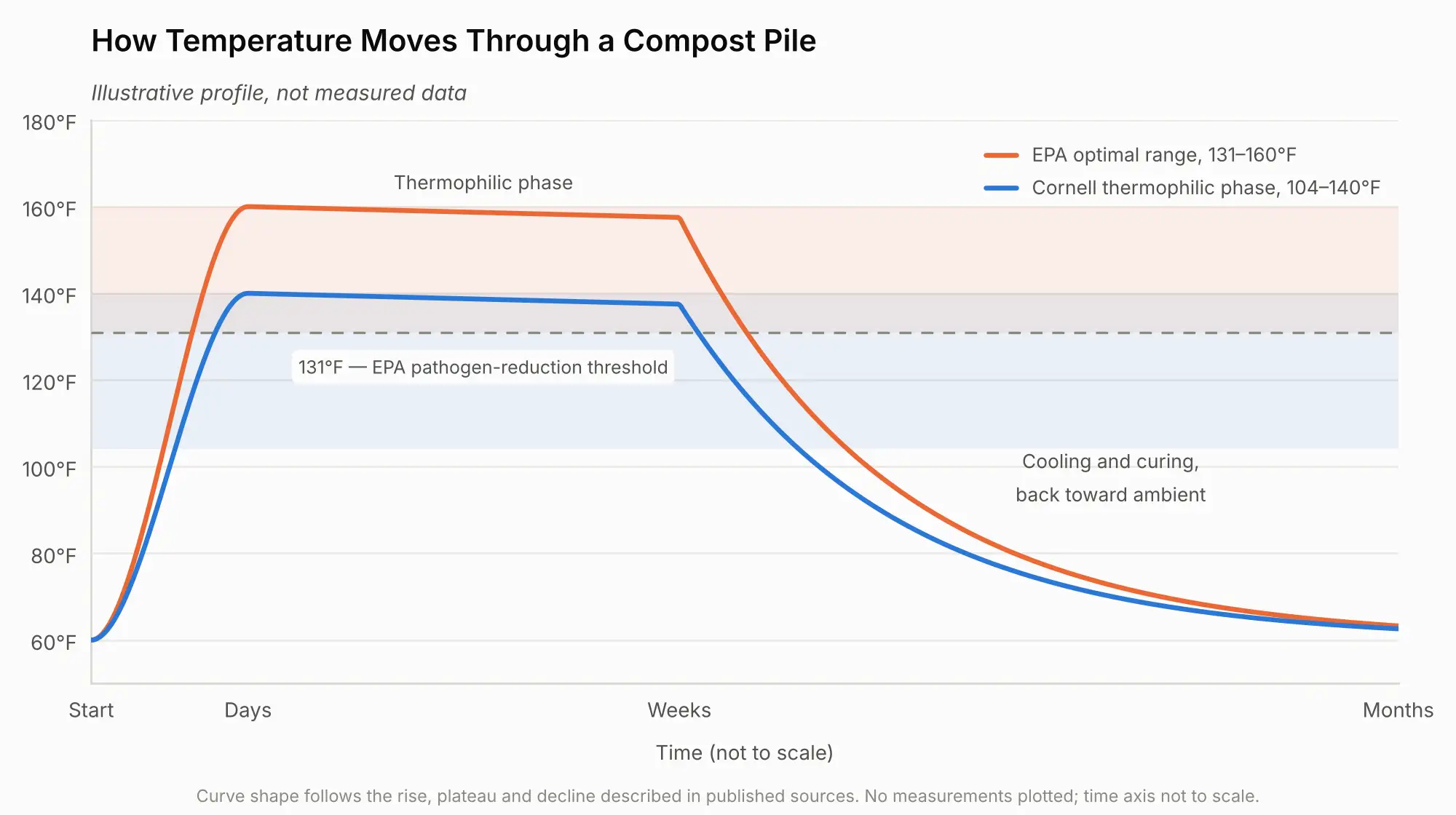
The heat is a byproduct of microbial activity, and it matters because it does work nothing else does. The EPA puts the optimal range for those microorganisms at 131 to 160 degrees Fahrenheit. It notes a pile must stay at 131 degrees or above for several days to meet standards for reducing pathogens. The agency states the requirement in the positive: those temperatures help reduce the presence of pathogens and weed seeds. A hot compost pile does that work; a pile that never reaches the range does not.
Size is the other half of a hot compost. Illinois Extension puts the efficient range at a pile 3 to 5 feet on a side so the center heats enough to break material down. It notes that smaller piles can still be built but take longer to produce finished compost. The EPA describes this passive aeration as a chimney effect: warm air heated by microbial activity rises to the top of the pile while cool air is drawn in through the sides and bottom to replace it.
Turning and Moisture
Turning does two things at once. It moves the cooler outside material into the hot center and opens up the pile so air can get back in. The EPA’s method is to use a garden fork to turn the outside of the pile inward. Moisture is checked by feel, using the wrung-out sponge test above. The EPA’s corrections are symmetrical. If the pile is too dry, moisten it and turn it. If it is too wet, add more browns or dry material and turn it. A well-maintained pile finishes in about three to five months. The agency advises letting it cure for at least four weeks. Those two numbers are the honest answer to how long a compost starter routine takes to produce anything usable.
Sources: EPA · Cornell University
Leaf Mold: The Slow, Cold Alternative
Not every pile needs to be hot. Leaf mold compost is what you get when leaves are left to break down on their own, and Penn State Extension describes the result as dark brown, crumbly, with a pleasant earthy smell. It is not nutrient-rich, but it improves soil structure and water retention, and it is mostly weed-free.
The method is as simple as it sounds: pile leaves, pack them down, water them, and wait. A bin, a large plastic bag, or a trash can keeps the pile tidy, though a corner of the yard works. Penn State puts the unassisted timeline at a couple of years. This shortens to six to twelve months by shredding the leaves, turning the pile, watering occasionally, or covering it with a tarp.
The difference from a hot pile is the organisms doing the work and the time they take. Fungi, bacteria, other microbes, mites, and insects break the leaves down slowly without the temperature spike. For anyone with more leaves than kitchen scraps, it is the lower-effort use of the fall pile and keeps bagged leaves out of the yard waste stream.
Composting Without a Yard
No yard rules out a traditional pile but not composting. Indoor composting covers several methods that differ more than the shared name suggests.
Vermicomposting. The EPA’s description is a container or bin, bedding material, worms, and food scraps. It takes up little space and can be kept indoors under a sink, in a closet, or in a basement, or outdoors in the shade. Results appear after three to six months. Unlike a backyard pile, vermicompost does not need to cure. The agency puts the ideal bin temperature at 59 to 77 degrees Fahrenheit, though the worms survive from 32 to 95 degrees.
Bokashi. Washington State University Extension describes bokashi as an anaerobic fermentation system for food waste, using a sealed container and an inoculated bran of beneficial bacteria and yeast. Scraps are layered with bran, pressed down, sealed, and the liquid is drained off. Fermentation takes about two weeks once the bin is full. One point matters for anyone planning to compost indoors with it: the result is not finished compost. It has to be buried in soil or added to a compost pile to finish. The extension service specifically says not to surface-apply it or plant immediately.
Drop-off. Many cities run food scrap drop-off sites or curbside organics collection. The EPA notes that communities may collect food scraps or offer a designated drop-off location. For apartment composting, this is often the simplest route, and the liner rules differ by program.
Anyone wondering how to start composting indoors should pick based on what they are willing to maintain. A worm bin is a small livestock operation. Bokashi is a two-stage process that still needs soil at the end. Drop-off needs only a container and a trip.
Odor, Winter and Other Common Problems
Two questions account for most of the troubleshooting, and both have specific answers rather than general ones.
Why a Pile Smells
A working pile smells like soil. When it does not, the smell identifies the problem. It usually points back to the same compost starter basics rather than anything exotic.
Ammonia means too much nitrogen. Cornell’s explanation is direct: at low carbon-to-nitrogen ratios, nitrogen is supplied in excess and lost as ammonia gas, causing undesirable odors. The fix is browns.
A sour, rotten smell points the other way: not enough air, usually from a pile that is too wet or packed too tightly. The EPA’s remedy for a too-wet pile is to add more browns or dry material and turn it.
So the honest answer to does compost smell is that a balanced, aerated pile does not. A smell is information rather than an inevitability. People asking do compost bins smell are usually describing one of these two states, and each points to a different correction.
Animals are the problem with no quick fix, which is why the keep-out list above is worth following rather than testing.
Composting in Winter
Cold slows a pile; it does not end it. The University of New Hampshire Extension notes decomposition slows once temperatures drop but only stops when the material freezes solid. Microorganisms stay active in the interior of a large bin.
Three things follow. Keep adding scraps through the winter but keep layering greens with browns because adding greens alone produces a wet, smelly mess at the spring thaw. Insulate the pile by surrounding the bin with bags of leaves or straw bales or by ringing the interior with six to twelve inches of leaves, sawdust, or wood chips. Leave the turning until spring since turning in winter releases the heat the pile has managed to hold.
Frequently Asked Questions
Can meat be composted?
Not in a backyard pile. The EPA lists meat, fish and bones among the materials to avoid because they attract animals. Rules vary by municipal organics program, so check your local program’s own page.
Can you compost rice?
The EPA lists cooked food among the materials to avoid, while noting that small amounts are fine, and rice falls in that group. The firmer limit is oil: fats, oils and grease are on the keep-out list because they attract animals, so an oily dish stays out whatever it is made of.
How long does a pile take to finish?
About three to five months for a well-maintained pile, per the EPA, plus at least four weeks of curing. A vermicompost bin produces results in three to six months and does not need to cure. Leaf mold on its own takes a couple of years, or six to twelve months with shredding and turning.
Do you need to buy an activator to start a pile?
No. Illinois Extension says commercial starters should not be necessary for a pile with a proper carbon-to-nitrogen ratio, and Iowa State Extension says an inoculant or activator is not necessary at all, recommending soil or finished compost layered with the plant material instead. The EPA’s composting page sets out the full method in terms of materials, moisture and aeration.
The Bottom Line
Ratio, moisture, air, and the structure and size of the pile. Get those right, and it heats on its own; get one wrong and no amount of compost starter will fix it. Keep meat, dairy, fats and pet waste out, hold leaves over from the fall so the browns last through summer, and read a smell as a signal rather than a verdict.