
Table of Contents
The machine behind a loading dock and the appliance under a kitchen counter share a name but almost nothing else. One is covered by a national safety standard that sets the height of its loading opening and the color of its stop button. The other is explicitly excluded from that standard’s scope.
That split is worth clarifying first because it decides which rules apply to an industrial trash compactor, who may press the button, and what the equipment can accept. What follows draws from the published safety standard, a university’s construction standards, a manufacturer’s specification sheet, a university’s list of banned dumpster items, a federal report on lithium-ion battery fires in waste facilities, and a federal dataset of landfill tonnages.
What the Word Covers, and the Kitchen Appliance It Does Not
A garbage compactor, in ordinary American usage, often means a residential under-counter unit as much as an industrial one. The national standard governing this equipment, ANSI Z245.2, settles the question for its purposes in a single line: the standard “shall not apply to compactors intended for use in private homes.”
Everything else is in scope. The standard’s foreword describes on-site equipment in apartment, institutional, commercial, and industrial settings, including transfer stations and recycling facilities. So when someone searches for an industrial trash compactor, the equipment they find is governed by rules unrelated to the appliance aisle: operator age minimums, interlocked access doors, and lockout procedures before anyone reaches into a jam.
The practical consequence is that the two machines cannot be compared by their specifications despite the shared name. A household garbage compactor compresses a bag of kitchen waste. The equipment described here compresses waste into a container up to 39 cubic yards that a truck hauls away. The people who load it must be trained and documented according to the standard.
The Types That Standards and Specifications Actually Define
Four names circulate in this market, but only some are publicly defined.
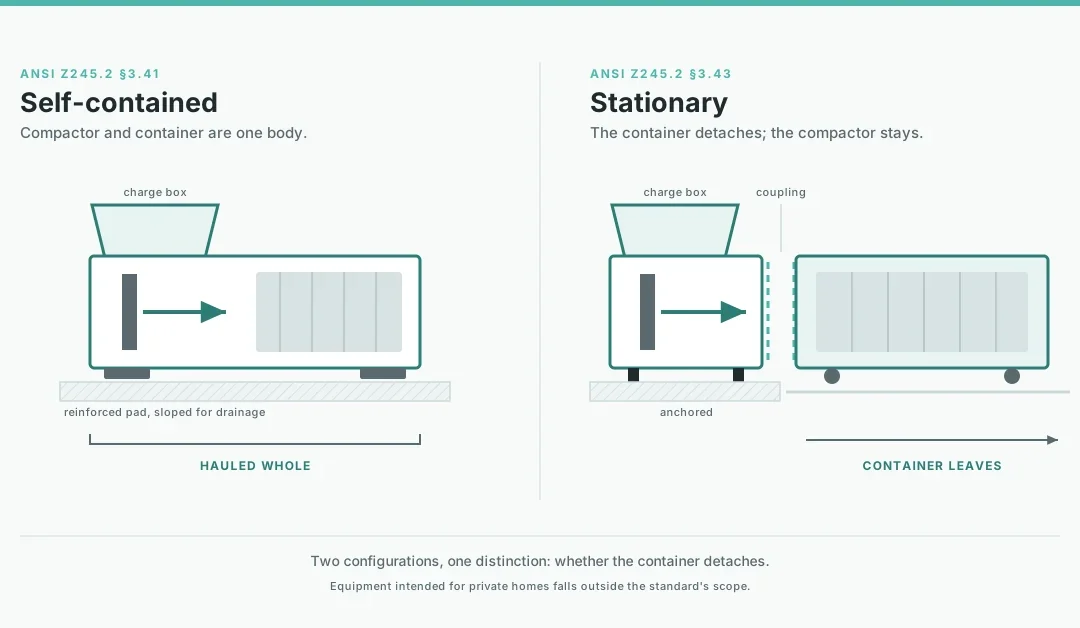
Self-contained compactor-container. ANSI Z245.2 defines this as “a powered machine that remains stationary during operation, designed to compact refuse into an integral container.” The compacting mechanism and the container are one unit, which is what “integral” is doing in that sentence.
Stationary compaction equipment. The standard defines these as “powered machines that remain stationary when in operation, and are designed to compact refuse into a container.” The distinction from the self-contained type is that the container detaches. The compactor stays bolted to its pad while a truck takes the full container and leaves an empty one.
Within the stationary category, the standard separates units by setting rather than by mechanism: apartment and institutional units on one side, and on the other, units used in businesses, industrial plants and waste processing, disposal, transfer and recycling facilities. A commercial trash compactor at a supermarket and an industrial garbage compactor at a manufacturing plant are, in the standard’s terms, the same category of machine serving different volumes.
Vertical balers. One university’s design standards list them as a distinct equipment type alongside compactors, with typical dimensions of 4 feet deep by 6 feet wide by 12 feet tall, against roughly 24 by 8 by 8 feet for a standard self-contained horizontal compactor. A baler produces bound bales; a compactor produces a dense load in a container. The two are specified separately because they are not interchangeable.
Pre-crushers. Neither ANSI Z245.2 nor the university construction standard reviewed here defines the term, though it is commonly used by equipment suppliers. Treat it as a vendor category rather than a technical class and ask what mechanism is actually described.
A commercial garbage compactor in a strip mall and one at a distribution center may differ only in size and duty cycle. The useful question is not which of the four names a machine has but whether its container detaches.
Capacity and Force: What the Numbers Mean
A manufacturer’s specification sheet for self-contained units lists container capacities from 19 to 39 cubic yards across two model families. The compaction force is 44,200 pounds on one family and 49,200 on the other, which the sheet translates to ram pressures of 29.5 and 27.6 PSI. Cycle times run 36 to 38 seconds. Both families use a 10 horsepower motor.
Those are the numbers that describe an industrial trash compactor honestly, because they are measurable at the machine. ANSI Z245.2 requires that the maximum force rating “shall be stated on the compactor manufacturer’s nameplate,” which means the figure is verifiable on any unit already installed.
The standard does not define a compaction ratio or require one to be stated. None of the three equipment documents reviewed — the safety standard, the university construction standard, or the manufacturer’s specification sheet — defines a compaction ratio or a test method for measuring one. This is important to know before treating an advertised ratio as a specification because, unlike the force rating, it is not a figure anyone must stand behind.
The figure that matters operationally is not the ratio but the result: how many pickups per month the site needs after installation compared with before. That number is specific to one site’s waste and is only known after a few billing cycles. See: Dumpster Sizes
What Can and Cannot Go In
The prohibitions are not specific to compactors. One university publishes a list of items banned from its trash cans and dumpsters, and the document never mentions compaction equipment — but the items include aerosol cans, antifreeze, appliances, asbestos-containing materials, ash, lighting ballasts, non-alkaline batteries, chemicals, compressed gas cylinders, electronic equipment, cooking oil and grease, fluorescent lights, infectious waste, lubricants and fuels, paints, pharmaceuticals, scrap tires, solvents, treated wood, and “refuse containing liquids.” Its preamble gives two general reasons: some items “may be regulated as hazardous waste when disposed,” others “may be considered special wastes and require certain specific permits.” One entry restricts hauling to a licensed solid waste transporter. On liquids the document states: “Landfill regulations prohibit disposal of liquids.”
Batteries deserve their own paragraph because crushing is the failure mechanism. An EPA report on lithium-ion batteries in the waste stream identifies 64 waste facilities that experienced 245 fires linked to lithium batteries between 2013 and 2020 across 28 states. It explains ignition directly: garbage trucks crush waste with on-board compactors, and “these compactors may damage LIBs, which sometimes leads to the batteries undergoing thermal runaway.” A damaged cell sometimes ignites the trash around it. The same report also describes a fire at a California materials recovery facility believed to have started when processing machinery crushed a battery.
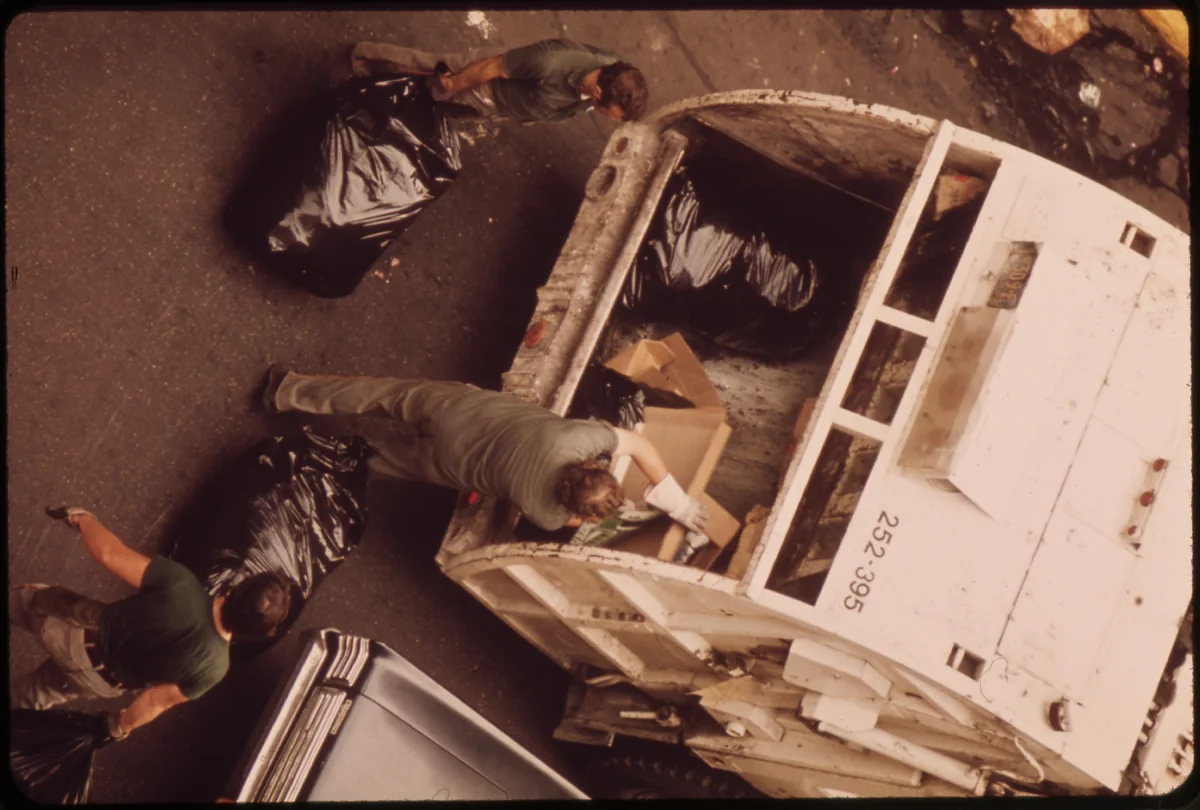
Photo by Gary Miller for the U.S. Environmental Protection Agency, DOCUMERICA, 1973 — U.S. National Archives (NAID 549844)
Compaction on Wheels
EPA’s report on lithium-ion battery fires in waste facilities describes garbage trucks crushing waste with on-board compactors. The machines this article covers do the same work without moving: ANSI Z245.2 defines them as powered machines that remain stationary when in operation.
The report does not extend that finding to stationary equipment: it describes on-board compactors in collection trucks and, in one case, processing machinery at a recycling facility, but says nothing about an industrial trash compactor on a pad. The mechanism it names is crushing, which all this equipment does. Aerosol cans and compressed gas cylinders are on the banned list above; the list gives no item-by-item reason beyond its two general ones.
Liquids are a quieter problem, settled by regulation rather than hazard: landfill rules prohibit disposing of them entirely. See: How to Dispose of Old Gasoline Safely and Legally
Siting, Power and Operator Safety
The published requirements fall into three groups. Together they explain why these installations are planned rather than improvised.
The pad and the approach. One university’s construction standards say pads for a standard self-contained compactor should be at least 12 feet wide by 28 feet deep. Pads must be built of at least 6 inches of reinforced 3,000 psi concrete over 6 inches of 6% subgrade preparation, sloped at 1/8 inch per foot for drainage. Container pads should abut the access driveway with at least 42 feet of clear space in front. Where the unit sits inside an enclosure, minimum inside dimensions rise to 27 feet deep by 11 feet wide, with gates that should not protrude into that space. Overhead clearance of at least 24 feet is specified to keep containers clear of wires and overhangs. Service driveways should be at least 22 feet wide and able to carry 65,000-pound vehicles.
Power. The manufacturer’s specification sheet lists tri-volt selection at 208, 230 or 460 volts, three phase, driving a 10 horsepower motor, with a remote power unit weighing 550 pounds with oil and holding a 25 gallon reservoir. The university’s construction standards separately require that power provided to a compactor be the same as that of existing units on campus, so spare compactors and parts remain usable — the kind of constraint that decides a purchase more often than any performance figure.
Safety. ANSI Z245.2 is specific. Loading chamber doors require an interlock that stops cycling motion while the doors are open. Where a guard, hopper or enclosure provides protection, the minimum loading height is 42 inches, and it must be interlocked so the unit cannot run without it. Emergency stop buttons must be red, distinguishable by size and color, and not recessed; they must be readily accessible or within 3 feet of the point of operation or the material feed area. The electrical disconnect must be within sight of the control panel and no more than 50 feet away. A key-lock security switch must disconnect power to the operating controls. Only authorized employees 18 or older may operate, inspect or maintain the equipment, employers must train them before assignment and keep records of names and dates, and lockout is required when inspecting malfunctions, jams or other problems arising from daily operations, and when servicing or performing maintenance, with maintenance testing excepted. Continuously operating units need a start-up alarm that is audible and visible for 5 seconds, and the main motor may not start until at least 15 seconds after the start control is activated.
Those three groups rarely sit with the same person. Siting an industrial trash compactor is a civil matter, the power is electrical, and the safety requirements belong to whoever is responsible if someone is hurt.
By the Numbers
Compaction changes volume, not mass. Whatever a compactor compresses still arrives at a disposal facility weighing exactly what it weighed on the dock. The federal record of that arrival is substantial.
EPA’s Office of Research and Development publishes a landfilled waste composition dataset assembled from state reporting. In 2020, the most recent year with broad coverage, it records 133,513,973 short tons of municipal solid waste landfilled across 376 reporting facilities in 18 states and Guam, counting each distinct facility name within a jurisdiction once. Those jurisdictions are not the country, and the reporting mixes fiscal and calendar years — 1,743 of the 2020 records are fiscal, 477 calendar — so the total describes what they reported rather than a national figure. Florida and Texas alone account for 23,543,459 and 23,444,429 short tons.
Set against those tonnages, compaction changes trips rather than totals. Every pickup is a truck movement, and fewer times a hauler must come to haul waste off a property is what the equipment is bought to produce. The weight landing at the facility at the end of the chain remains unchanged.
How Servicing Works, and Who Owns the Machine
The two configurations are serviced differently, following directly from how the standard defines them. A stationary unit compacts into a container that detaches, so the container leaves while the compactor stays bolted to its pad. A self-contained unit is one piece, so the whole body goes and returns.
Beyond that point, the published sources stop, and it is worth stating plainly rather than filling the gap. None of the standards or specifications reviewed here addresses service frequency, contract terms, or the waste stream of any particular trade; restaurant waste management and retail packaging waste fall outside their scope. Ownership is also outside their scope. A machine may be bought, leased, or supplied by a hauler under a service agreement. Nothing in a safety or construction standard depends on which — a trash compactor rental is a commercial arrangement, not a regulated one.
What the standard fixes is where the duty lies once the machine runs, whoever holds title to it. ANSI Z245.2 places training before assignment, training records, lockout, and conformity of the installation to local codes and ordinances on the employer. A property that does not employ the people loading the hopper still needs to know who does.
Frequently Asked Questions
Does a kitchen compactor follow the same rules?
No. ANSI Z245.2 “shall not apply to compactors intended for use in private homes.” The age, training, interlock and lockout rules above cover on-site equipment in apartment, institutional, commercial and industrial settings.
How large is a self-contained compactor container?
The specification sheet reviewed here lists 19 to 35 cubic yards in one model family, 23 to 39 in another. One university’s standards say compactor pads should be at least 12 by 28 feet, and container pads at least 42 feet of clear space in front.
What compaction ratio should you expect?
None of the three equipment documents reviewed here defines a compaction ratio or a test method for one. The standard requires only the maximum force rating on the nameplate; the sheet reviewed here states 44,200 and 49,200 pounds for two model families.
Who is allowed to operate one?
Only authorized employees 18 or older, trained before assignment, with the employer keeping records of names and dates. Lockout is required when inspecting malfunctions, jams or other problems arising from daily operations, and when servicing or performing maintenance, maintenance testing excepted.
Can batteries go in?
Non-alkaline ones, no. An EPA report counted 245 fires at 64 waste facilities from 2013 to 2020 linked to lithium batteries, and describes on-board compactors in collection trucks — not stationary units — as crushing that may damage a cell, which sometimes leads to thermal runaway. The ban list reviewed here never mentions compactors, but it bans non-alkaline batteries.
The Bottom Line
An industrial trash compactor is a defined class of equipment with published requirements for nearly every part: a 42-inch minimum loading height where guarding is used, a red non-recessed emergency stop, a disconnect within 50 feet, a nameplate stating the force rating, operators 18 or older with documented training, and a reinforced pad sloped for drainage with room for a truck in front. The standard neither defines nor requires a compaction ratio, which remains a vendor figure.
The one risk worth acting on before the rest is what goes into the hopper, and batteries are the documented case. EPA’s report on lithium-ion batteries in the waste stream counted 245 fires at 64 waste facilities over eight years and identified crushing by compactors as a mechanism that may damage a battery and trigger thermal runaway. A compactor is a crushing machine by design, and it does not know what it is crushing.