
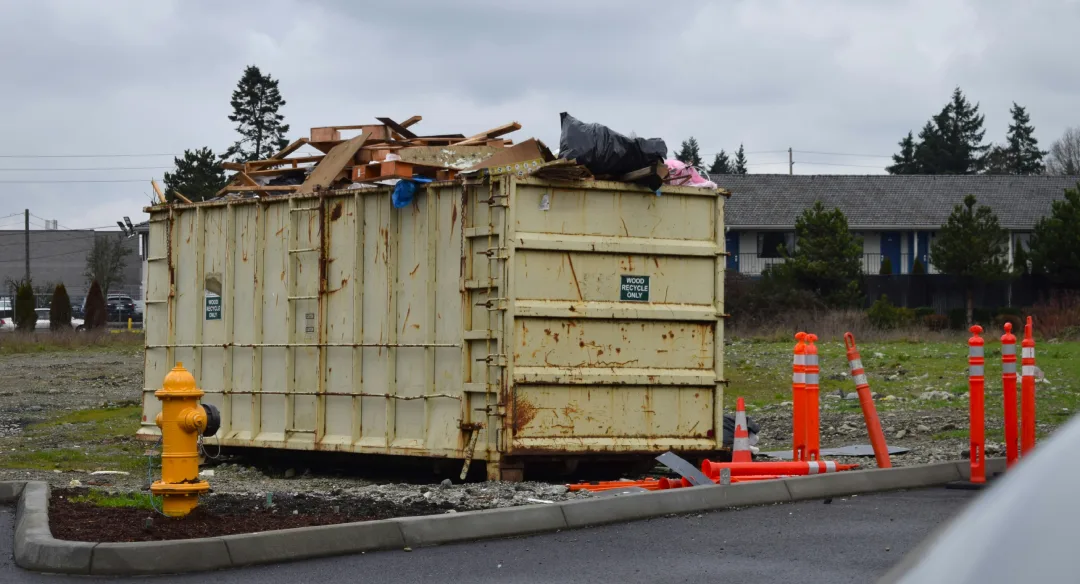
Dumpster Sizes:
Picking a container is the first decision of any cleanout and the one that costs twice when it goes wrong. Order something too small and the hauler returns for a second load. Order something too large and you pay to move air. The trap is that the number on the container describes volume only, while the invoice is often settled by weight.
There are two separate families of container, built for two different jobs: the open-top box dropped off for a few days, and the lidded bin emptied on a schedule behind a store. Most people comparing containers want the first one. The chart below covers both, and the sections after it explain what the numbers mean once a real pile of debris goes in.
How Container Volume Is Measured
Every container in this guide is rated in cubic yards. One cubic yard is a cube three feet on each side, and it works out to just under 202 gallons. A standard 33-gallon trash bag therefore fills roughly a sixth of a cubic yard, so about six loosely packed bags per yard is a reasonable mental conversion. A 12-yard box holds something like 72 of them.
A rating is not a set of dimensions and the two do not reconcile as expected. Published outside measurements include walls, rails, and the sloped nose, so multiplying them rarely matches the rating. One public program lists its 10 yard box at 15.5 by 8 by 4 feet, which multiplies to more than 18 cubic yards. The rating is the hauler's usable capacity, not the shell's arithmetic.
Containers rated the same can look very different. Among published specifications for a 10 yard roll-off, one is 15 feet long with two-foot walls and another is 12 feet long with three-foot walls. Both carry the same rating. This matters: a low box can be loaded over the side by hand, while a tall one usually must be filled through the rear door or over the top.
The rating says nothing about what the container is allowed to carry. That limit is set by the hauler and the truck's legal axle weight, and it is where most sizing mistakes occur. Comparing dumpster sizes by volume alone turns a correctly sized box into an overweight one.
Dumpster Sizes Chart
The figures below are compiled from published specifications: two public waste programs and three hauler fleets, including the largest national one. Where sources disagree, the full range appears because dimensions vary between fleets for the same rating. The bag counts are calculated from the gallon conversion above, not from any specification sheet. Treat the table as a baseline to check against a local quote.
Published dimensions vary between haulers, so use these as a baseline to check against a local quote. Bag counts are calculated at about six 33-gallon bags per cubic yard, not taken from a specification sheet.
Scheduled-service bins: 1 to 8 yards
Permanent bins emptied on a contracted schedule. Dimensions below are published by a county solid waste program.
1 yard
2.5 × 6 × 3 ft
About 6 bags
2 yard
3 × 6 × 3 ft
About 12 bags
3 yard
3.5 × 6 × 4 ft
About 18 bags
4 yard
4.5 × 6 × 4.5 ft
About 24 bags
6 yard
5.5 × 6 × 4.5 ft
About 36 bags
8 yard
Offered; dimensions not published in sources consulted
About 48 bags
Small roll-offs: 10 and 12 yards
The low boxes. These are the ratings the major fleets designate for heavy materials, because weight runs out before volume does.
10 yard
12–15.5 ft × 8 ft × 24–48 in.
About 60 bags
12 yard
12–14 ft × 8 ft × 41–48 in.
About 72 bags
Mid-size roll-offs: 15, 16 and 20 yards
The 15 and 20 are carried by the larger fleets. The 16 is not a rating you can assume a local hauler stocks.
15 yard
10–15 ft × 7 ft 11 in.–8 ft × 55–57 in.
About 90 bags
16 yard
Not published by the fleets consulted
About 96 bags
20 yard
21 ft 11 in.–23.5 ft × 7–8 ft × 42–54 in.
About 120 bags
Large roll-offs: 30, 40 and 42 yards
Built taller rather than longer, so they add volume without adding footprint. Reserved for bulky debris that is not dense.
30 yard
22–23.5 ft × 8 ft × 52–78 in.
About 180 bags
40 yard
21 ft 11 in.–23.5 ft × 7–8 ft × 78–102 in.
About 240 bags
42 yard
Offered by one major fleet; dimensions not published
About 252 bags
Two patterns stand out. First, width is nearly fixed while length and height vary: published roll-off widths run from seven to eight feet, and one city caps width at 96 inches, so length and overhead room are the measurements to check against a driveway. Second, published lists of dumpster container sizes concentrate on 10, 20, 30, and 40 yards, with 12 and 15 carried by larger fleets, while the published waste container sizes for scheduled service run from one to eight yards. Ratings outside those ranges exist but must be requested by name.
The Type column separates the two families by a mechanical distinction. A roll-off arrives on a truck with a winch and tilting bed, sits on the ground, and leaves full. A scheduled-service bin stays on site and is emptied into the truck where it stands, either tipped over the cab by forks or wheeled into a hopper at the rear. The two families overlap in rating but not in use, so dumpster sizes only compare meaningfully within one family. Dimensions and clearance needs differ between the two designs for the same rating.
Roll-Off Container Sizes
Roll off containers are the open-top boxes delivered on a truck with a winch and a tilting bed, left on site, then hauled away full. Four ratings appear in every published list consulted for this guide: 10, 20, 30 and 40 cubic yards. The 12 and 15 yard are carried by the larger fleets, and one regional hauler also runs a 42. The 20 and 30 yard boxes are the volume workhorses of the group, each with a section of its own in our guide to the [INTERNAL LINK: 20 Yd Dumpster] and sized for debris that takes up room without weighing much. The 15 yard gets its own treatment in [INTERNAL LINK: 15 Yard Dumpster]. More options across both families are collected under [INTERNAL LINK: Dumpster Rental & Containers].
The pattern across these containers is that volume and capacity run opposite once debris gets dense. Bigger boxes are built taller, not longer, so filling one with heavy material produces a load beyond what the hauler will carry and sometimes beyond the truck's legal road limit. That is why published roll off dumpster sizes do not match published weight allowances.
10 and 12 Yard
These small, low containers are the right answer more often than their size suggests. Published wall heights run from two to four feet, allowing debris to be dropped over the side instead of wheeled through a door.
They are also where the industry puts dense material. The largest national hauler lists its 10, 12, and 15 yard boxes for "heavy materials" and "concrete, asphalt or dirt disposal," but not the larger boxes. One public waste authority prohibits brick, dirt, rock, tile, and shingles in containers over 20 cubic yards. The arithmetic explains the caution. Federal conversion factors put dirt and sand at 929 pounds per cubic yard and broken concrete at 860. Fill a 10 yard box with dirt and it weighs about 9,290 pounds, or roughly 4.6 tons, before anything else goes in. The same material in a 30 yard box would weigh nearly 14 tons. This clearly shows dumpster sizes and usable capacity pointing in opposite directions.
A 12 yard dumpster is the natural step up when the pile is dense but larger than a single room: a bathroom gut, patio demolition, or small tear-off. Two fleets publish the same specification: 12 feet long by 8 feet wide with 41-inch walls, while a third lists 14 feet and 48 inches. At the gallon conversion, that is roughly 72 trash bags of loose material. One fleet lists its box at 75 bags or five pickup truck loads. Some haulers call it a 12 cubic yard dumpster; others call it a 12 yard roll off dumpster, and the two terms describe the same thing. When pricing a 12 yard dumpster rental, ask what tonnage the quote includes rather than assuming it scales with volume.
14, 16 and 25 Yard
None of these three appears in the published size lists of public programs and major fleets consulted for this guide. A 14 yard dumpster, 16 yard dumpster, and 25 yard roll off dumpster appear in regional fleets, with the 25 offered in several markets, but none is a rating you can assume a local hauler stocks.
That has two practical consequences. If one of them appears in a quote, ask for the dimensions and the included tonnage rather than assuming it behaves like the nearest familiar rating, because the one published 16 yard specification found for this guide is identical to another fleet's published 12 yard. And if you are comparing quotes across haulers, these ratings make the comparison harder rather than easier, since there is no shared reference for what they hold.
40 Yard and Larger
A 40 cubic yard dumpster is the largest rating in general circulation, published at 21 feet 11 inches to 23.5 feet long and 78 to 102 inches tall. Those tall walls add volume without increasing footprint, so the box occupies roughly the same ground as a 20 yard while holding twice as much. A 40 yard roll off is the usual choice for interior demolition, commercial cleanouts, and bulky but light debris. Cardboard and packaging are the textbook case, which is why a 40 yard trash bin behind a warehouse fills long before it gets heavy.
It is not the end of the range. One regional hauler publishes a 42 yard roll-off alongside standard ratings, and one manufacturer's catalog offers open-top boxes from 6.5 to 50 cubic yards, citing density as the reason for the spread: the smallest are built for stone and dirt, the largest for cardboard and wood. Whatever the paperwork says, a 40 yd roll off dumpster has a practical ceiling well below its volume. At the federal conversion factor for mixed construction and demolition debris, 417 pounds per cubic yard, a full 40 yard box runs about 8.3 tons. Loading a 40 yard roll off container with anything heavier than loose debris reaches the truck's limit long before the box looks full.
Scheduled-Service Bins: The Other Family
The lidded steel bins behind restaurants and apartment buildings belong to a different service model. They stay on site permanently, get emptied on a contracted schedule, and are billed by size plus pickup frequency rather than by load. Published ratings run from one to eight cubic yards. What matters more than rating is the product of rating and frequency: a 3 yard bin collected twice a week moves about 26 cubic yards a month, while a 6 yard bin collected once a week moves the same amount. Doubling the bin and halving pickups is a wash on volume, so the choice comes down to space, access, and cost.
Clearance is the practical constraint on these bins because the truck must work where the bin stands. One city's staging diagrams require 24 feet of overhead clearance to lift a container and a minimum 10-foot drive aisle left clear. If scheduled service is what you are pricing, the sizing logic differs enough to warrant its own guide: see [INTERNAL LINK: Commercial Dumpster Sizes].
Types of Dumpsters Beyond Size
Rating is only one axis. Asking about types of dumpsters usually turns up four variations that matter more than a few cubic yards either way. These are trade categories rather than published standards, so names vary between haulers and are worth confirming when you order.
A **lowboy dumpster** is a roll-off built deliberately short, with sidewalls lower than a standard box of the same footprint. When material is especially dense, a container with lower sidewalls keeps the load under the weight limit while staying easy to fill by hand. For masonry, soil, and broken paving, this is the container to ask for by name.
A **concrete dumpster** is the same idea applied to one material. Haulers reserve specific boxes for clean concrete, brick and block, because that material has a destination: more than half of all construction and demolition debris is processed into aggregate rather than landfilled. One county's disposal schedule prices rubble separately from mixed waste, which is the mechanism that makes a clean load worth keeping clean.
A **plastic dumpster** is a lighter-duty container, usually a wheeled or skid-mounted bin used on light-debris sites, in tight interior spaces, or where a steel box would mark a finished surface. Capacities are small and they are not meant for masonry.
A **cardboard dumpster** is a bin dedicated to corrugated board at a store or warehouse. Keeping cardboard separate is a volume decision as much as a recycling one: uncompacted corrugated runs about 75 pounds per cubic yard and flattened about 106, so it fills a container fast while adding almost nothing to the weight.
Matching a Size to Your Project
The best method is to start from the heaviest material in the pile, not the size of the room.
**Single-room remodel.** A bathroom or a small kitchen generally fits a 10 or 12 yard box. Tile, plaster and cast fixtures are dense, and the low walls make loading faster.
**Whole-home cleanout.** Furniture, carpet, boxes and household goods are bulky and light. A 30 yard box is usually right, and a 40 is justified when large furniture dominates.
**Landscaping and hardscape.** Soil, sod and broken paving are the densest common debris. Two small loads will often clear a job that one large box legally cannot, and some haulers will not accept these materials in their larger boxes at all.
**Roof tear-off.** A roofing dumpster is sized by squares, not rooms. A square is 100 square feet of roof surface, so a 2,000 square foot roof is 20 squares. How much a square weighs depends entirely on what is coming off, since a single layer of three-tab shingles and a double layer of architectural shingles differ widely. That figure must come from product data or the roofer, not a general rule. What can be calculated in advance is the container side. Asphalt roofing converts at 731 pounds per cubic yard, so every cubic yard of tear-off in the box adds just over a third of a ton: a 12 yard box filled with shingles runs roughly 8,800 pounds, or 4.4 tons. Work backward from the hauler's included tonnage to find the largest box that stays under it, and ask for a low-wall container so shingles can be shoveled over the side instead of carried through a door.
Published dumpster rental sizes are a starting point for all four cases, not a final answer. The question to ask any hauler is what tonnage the quoted price includes.
Where the debris goes afterward is worth knowing, because it shapes those prices. Federal figures put construction and demolition debris generation at 600 million tons in 2018, more than twice the tonnage of municipal solid waste from all residential, commercial and institutional sources combined. Of that total, 52.1 percent was processed into aggregate and 21.9 percent into manufactured products, while 23.9 percent went to landfill. Single-material loads are what make the first two figures possible, and the effect is measurable: one state's waste studies recorded roofing shingles falling from 29.5 percent of landfilled construction debris in 2009 to 10 percent in 2020, as the material was diverted into road surfacing instead. Our guide to the [INTERNAL LINK: 20 Yd Dumpster] follows that path in detail.
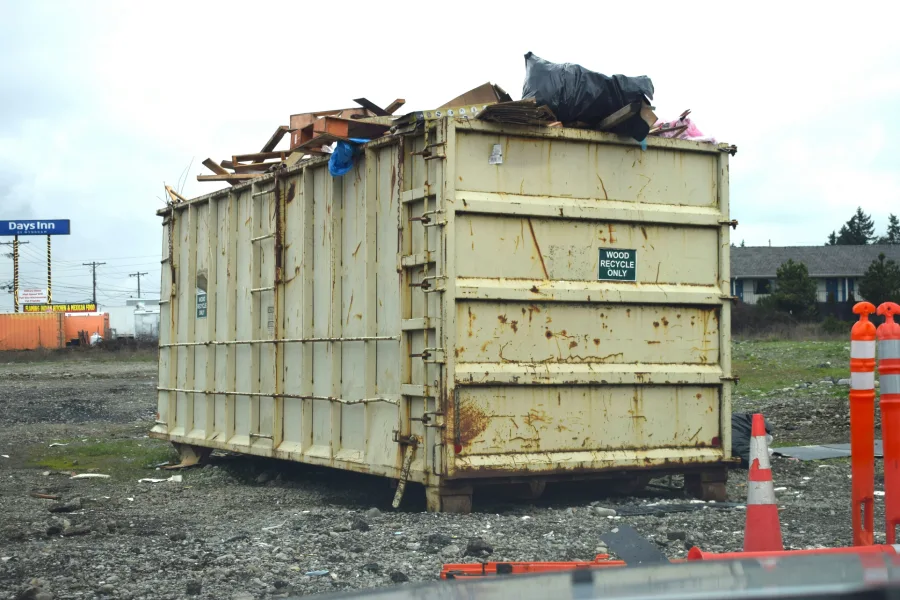
Roll-off container dedicated to wood recycling
Haulers keep containers dedicated to a single material because clean loads have a destination: more than half of all construction and demolition debris is processed into aggregate or manufactured products rather than landfilled. Mixing wood or drywall into a dedicated box can cancel that
Weight Limits and Where Sizing Goes Wrong
Almost every rental includes a tonnage figure, either as an allowance with a per-ton charge above it or as a hard maximum the hauler will not exceed. This is where published dumpster sizes stop being useful alone. One county charges $56.50 per ton plus a state surcharge to tip a commercial roll-off load, showing the scale: a container a few tons over allowance is a meaningful invoice line, not a rounding error. The same schedule prices rubble, shingles, and drywall by the cubic yard rather than by the ton, so what goes in the box changes both the rate and the unit charged.
Federal volume-to-weight factors make exposure easy to calculate before ordering. Per cubic yard: dirt and sand 929 pounds, concrete 860, asphalt paving 773, asphalt roofing 731, gypsum board 467, clean dimensional lumber 169, mixed construction and demolition debris 417. Multiply the factor by the container rating and compare the result to the tonnage in the quote. If the number is higher, the container is wrong no matter how well the volume fits.
Four errors cause most overage bills. First, ordering by volume and ignoring density. Second, sizing up as insurance: a larger box costs more and, being taller rather than longer, does nothing to help with a heavy load. Third, forgetting vertical clearance since the truck needs room overhead to raise its bed; a low branch or carport stops the job before it starts. Fourth, loading above the fill line, which makes the box unsafe to tarp and often illegal to transport, so it must be reloaded or refused.
Loading technique is a separate skill from choosing a size, and it has its own treatment in our [INTERNAL LINK: 20 Yd Dumpster] guide. For the regulatory background on how construction and demolition materials are classified and managed, the [Environmental Protection Agency's guidance on sustainable management of construction and demolition materials](https://www.epa.gov/smm/sustainable-management-construction-and-demolition-materials) is the authoritative starting point.
Frequently Asked Questions
How many trash bags fit in a 12 yard dumpster?
About 72 standard 33-gallon bags, calculated from the gallon conversion rather than measured. One cubic yard is just under 202 gallons, which works out to roughly six bags per yard loosely packed, and one hauler publishes 75 bags for its own 12 yard box. Compressing the load or breaking down cartons raises that number considerably.
Which dumpster size is best for a single-room remodel?
A 10 or 12 yard container in most cases. Single-room debris is dense rather than voluminous, and these are the ratings the major fleets designate for heavy materials, with walls low enough to load tile, plaster and fixtures over the side instead of carrying them through a door.
Why do two dumpsters of the same size have different dimensions?
Because the rating is a statement of usable capacity, not a calculation from the shell. Published outside measurements include walls, rails and the sloped nose, so they do not multiply out to the rating, and each fleet builds to its own pattern. Among published 10 yard specifications, one box is 15 feet long with two-foot walls and another is 12 feet long with three-foot walls. Size the space from the hauler's own figures, never from the rating.
Can I rent a dumpster for concrete only?
Yes, and it is usually the better option. Haulers keep dedicated containers for clean concrete, brick and block because that material is crushed and reused rather than landfilled, and disposal schedules price it separately from mixed waste. Mixing wood or drywall into one can cancel that treatment.
What size dumpster fits in a residential driveway?
Published roll-off widths run from seven to eight feet, and one city caps container width at 96 inches, so width is rarely the binding constraint. Length and clearance are. A 10 or 12 yard box runs 12 to 15.5 feet, while 20, 30 and 40 yard boxes all run around 22 feet, and the truck itself needs more: the same city's rules put the chassis at 23 feet, require a 40-foot turning radius, and call for 25 feet of vertical clearance. Carports, low branches and covered entries rule a driveway out regardless of how well the box itself would fit.
Conclusion
The useful way to compare dumpster sizes is to treat the rating as half the specification. Volume decides whether the debris fits; density decides whether the truck can take it away. Start from the heaviest material in the pile, check it against the published conversion factor, and ask every hauler what tonnage the quote includes and what the box actually measures. Done in that order, a 10 yard box frequently turns out to be the right answer for a job that looked like it needed a 30.