
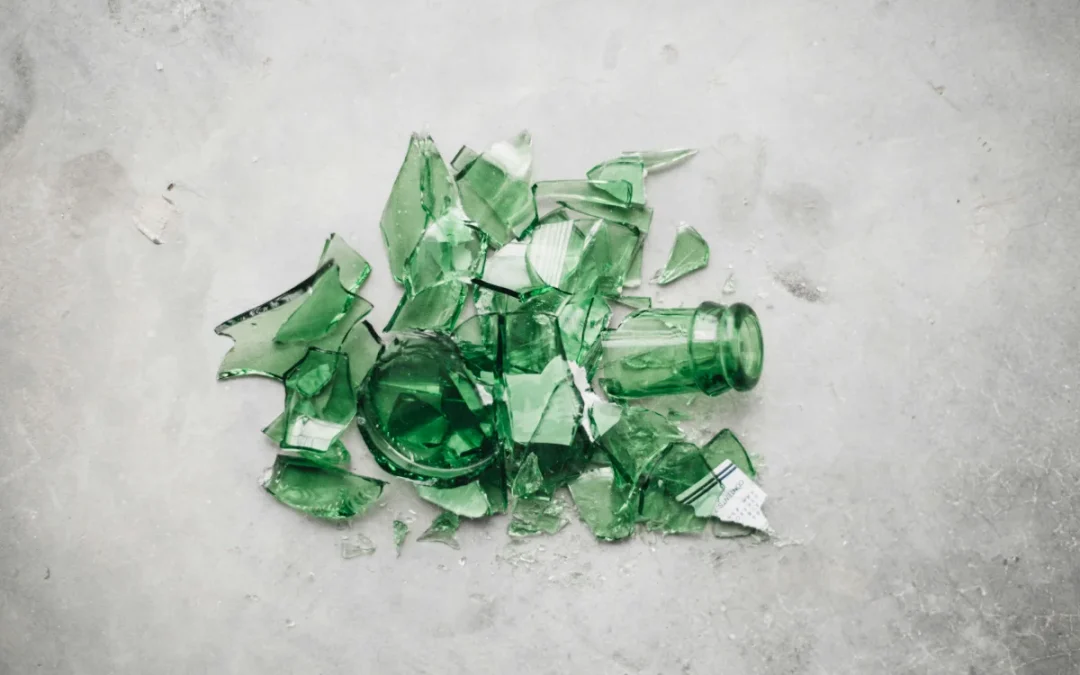
Photo de CHUTTERSNAPsur Unsplash
Table of Contents
A glass jar is the easiest thing in the bin to feel good about. It is pure, heavy, obviously not plastic, and everyone has heard it can be melted down forever. Then your city announces glass is no longer collected at the curb, and the story stops making sense.
Both halves are true, and the gap between them is where glass recycling actually sits. The chemistry is as good as anyone claims. The collection system meant to deliver that chemistry a clean supply of material is where most losses happen. What follows is the route a bottle takes from the cart to the furnace, why fewer than a third of containers come back, and what your program will and will not take.
What Happens to a Bottle After Collection
The first stop is a materials recovery facility, the sorting plant that receives everything from a commingled cart. Glass is not sorted there carefully. It is separated mechanically, usually on a screen that lets heavy, already-broken fragments fall through while paper and containers ride over the top.
What falls through is not yet usable. It is a mixture of colors with ceramic chips, bottle caps, paper labels, and food residue. Turning that into something a glass plant will buy happens elsewhere, at a separate beneficiation plant, and this step is often skipped in descriptions.
There, the material is cleaned of contaminants, sorted by color, and only then crushed and screened to size. The order matters: a study for Ohio's natural resources agency specifies that grinding is done after optical sorting. The output is cullet, the industry's name for processed glass ready to be remelted, sold by color and cleanliness.
Color sorting is not universal. The same Ohio study describes one processor whose configuration cannot separate three-color mixed glass. Minnesota's Pollution Control Agency documented a container plant that stopped buying optically sorted mixed glass because the price did not justify it and found installing its own sorter cost-prohibitive. Where that capacity is missing, mixed cullet has nowhere good to go.
Glass Does Not Degrade, but the System Loses It
Soda-lime-silica glass really does not wear out. Remelting does not change what it is: what comes out of the furnace is chemically the same material that went in, which is not true of every recyclable. A bottle can become a bottle again, and again, with no inherent limit.
That is a statement about the material, not the system, and the two are routinely confused in accounts of glass recycling. The claim that glass can be "endlessly recycled without loss in quality or purity" comes from the glass packaging industry's trade association, on a page carrying no date. No federal agency or peer-reviewed source consulted for this article puts it that way.
Independent work shows loss at every pass. Oregon's Department of Environmental Quality, in its 2022 life cycle assessment of glass collection and recycling, assumed a yield loss of 10 to 30 percent depending on the pathway. Breakage, contamination, and color mixing all take a share.
Color mixing cannot be undone. A furnace making clear containers needs cullet at least 95 percent clear; fiberglass production can tolerate 20 to 40 percent amber. Clear cullet has the widest range of uses, and green cullet can essentially only become green glass. Once colors are commingled beyond sorting, that material leaves the container loop for good.
Why Only Three Bottles in Ten Come Back
For 2018, the most recent year the Environmental Protection Agency has published, 3.06 million tons of glass containers were recycled in the United States out of 9.79 million tons generated. That is a rate of 31.3 percent. Of the rest, 1.31 million tons were burned for energy and 5.42 million tons were buried.
You will also see 25 percent quoted, from the same agency and the same tonnage recycled. The difference is the denominator: 25.0 percent divides those 3.06 million tons by all glass generated, a larger category than containers alone that includes glass no curbside program collects. For most people's question, 31.3 percent is the figure that answers it. One caveat applies to both: the agency combines data from the packaging industry's trade body with information from state environmental agencies, so the government and industry numbers are not fully independent.
The gap between what is collected and what glass recycling returns to a furnace is largely a breakage story. Minnesota's Pollution Control Agency found glass breakage is more prevalent in single-stream processing and explained why: side-loading trucks drop material two and a half to three feet, while some front-loaders drop it more than eight feet. In that 2006 study, one hauler's glass recovery fell from near total under source separation to 80 to 85 percent after switching to commingled collection. Another was sending roughly 12,000 tons of broken glass a year to landfill, a figure from a 2002 grant application.
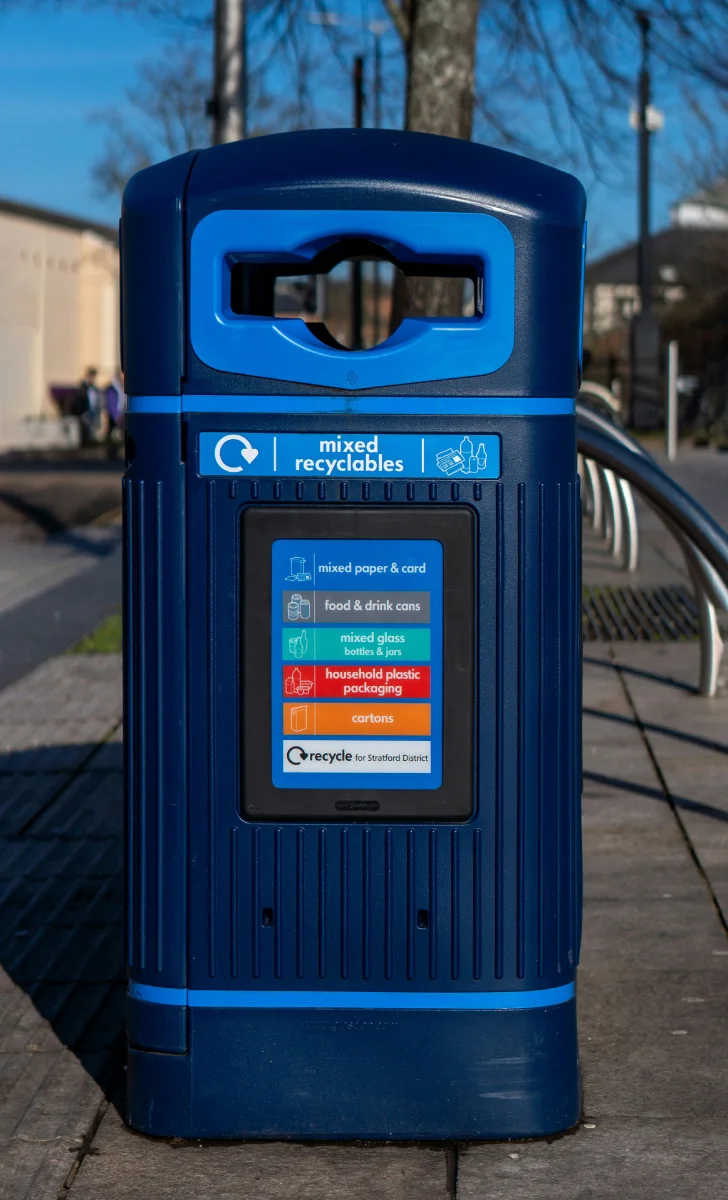
Photo by Rob Wingate on Unsplash
Side-loading trucks drop material two and a half to three feet into the hopper, and some front-loaders drop it more than eight feet. Minnesota's Pollution Control Agency found one hauler's glass recovery fell from near total under source separation to 80 to 85 percent after the switch to a commingled cart.
The shards do not stay put. A 2017 account co-authored by a North Carolina state recycling official described a sorting plant where over a third of incoming glass rode over the screens and cross-contaminated other materials or ended as residue. That plant later rebuilt its screening and fixed the problem, which is the point of the account. Fairfax County, Virginia, dropping glass from curbside collection in October 2019, summarized the chain in one sentence: glass breaks during collection and transport, and broken glass contaminates bales of more valuable materials such as cardboard and metals. It also abrades sorting machinery and, being heavy, raises the cost of moving everything else.
So is glass recyclable in practice or only in principle? Both, depending on how it reaches the plant. Knoxville stopped taking it at the curb in January 2017 and Fairfax County in October 2019. But the trend is not one-way: Houston dropped glass in 2016 and brought it back in April 2019 under a new processing contract. What changes between those decisions is the contract and sorting capacity, not the glass.
Minnesota's report adds a caveat worth keeping: problem loads of glass were just as likely to come from dual-stream plants as from single-stream ones. The same report still names the move to single stream as the main reason clean, color-separated cullet became scarce.
What Your Program Accepts, and What It Refuses
Bottles and jars are the core of what programs collect. Beyond those shapes, glass recycling rules are stricter than most expect. Mississippi's environmental agency lists what is refused and why. Window glass, light bulbs, drinking glasses, ceramics, mirrors, auto glass, heat-resistant ovenware, and crystal are all to be thrown away, and the agency gives one reason for the whole list: these materials melt at different temperatures from container glass. Pierce County, Washington, puts it in terms of composition rather than heat, telling residents that glassware, dishes, windows, and mirrors contain different additives than container glass and belong in the garbage.
The tolerances are unforgiving. Cullet specifications in the Ohio study allow ceramic content of 40 to 70 parts per million. Research presented at a glass industry conference found ceramic and glass-ceramic pieces smaller than five millimeters may still end up as defects in finished glass, and that sorting equipment struggles to tell them apart from ordinary container glass.
Window glass deserves a correction to usual advice, because the blanket reason fits ceramics better than it fits a pane. The Ohio study describes plate glass as mostly clear and blendable with container glass to meet most specifications, counting thousands of tons as recoverable supply. It stays out of your cart because of how it arrives, broken, framed, laminated, or coated, rather than because it wrecks the melt. Ceramics are the opposite: excluded precisely because of what they do inside the furnace. Either way, your program keeps both out.
If you wonder how to dispose of glass your program refuses, the answer is almost always the trash. The reason is not indifference. Against a tolerance measured in tens of parts per million, one ceramic mug is a large quantity.
Getting Rid of Glass That Cannot Be Recycled
Whatever you put out, someone handles it. Collection crews lift and empty containers, and sorting line staff pick material off moving belts by hand, and municipal guidance on broken glass is written accordingly.
Knowing how to discard glass safely takes about a minute. Royal Oak, Michigan, tells residents to wrap broken glass and mirror in heavy paper or put it in a cardboard box or lidded metal can, then set it out with regular refuse. The same page is blunt about the other half: do not put broken glass with recycling. Pierce County, Washington, gives the same destination plainly: place broken glasses, dishes, windows, mirrors and all other glass in the garbage.
The question arrives in another form after a renovation or a move: how do you get rid of glass in bulk? Large quantities of window glass, mirror or shower door glass are often handled as construction debris rather than household waste, which may mean a separate drop-off or a container rental.
Weight, Distance, and Where to Take Glass Your Cart Refuses
After the sorting problems come the freight problems, and they are frequently decisive. Glass is heavy and worth little per ton, so the distance between a sorting plant and a furnace is what decides whether glass recycling happens at all. The glass container industry operates 49 plants across 22 states, meaning 28 states have none. Mississippi's environmental agency puts the consequence plainly: shipping glass to the plants that buy it, in Texas and Georgia, generally costs more than the material earns.
There is a figure people reach for here that does not exist. No federal or state agency publishes a break-even hauling distance for glass, and this article will not invent one.
Where do you recycle glass when the curbside cart will not take it? Two routes exist. Drop-off depots, run by a city, county, or processor, keep glass separate from the start and avoid the breakage that commingled collection causes. Ten states run container deposit programs, where the deposit you paid is refunded on return: California, Connecticut, Hawaii, Iowa, Maine, Massachusetts, Michigan, New York, Oregon, and Vermont. Delaware had one but replaced it with curbside collection in 2010, which is why older lists sometimes say eleven.
When Recycling Glass Is Not the Better Option
This is where a state agency says something almost nobody else will. Oregon's Department of Environmental Quality, in its 2022 life cycle assessment of glass collection and recycling, concluded closed-loop recycling is not automatically better than open-loop, that the end market is critical to the outcome, and that landfilling can be less impactful than some glass recycling pathways, especially where drop-off depots are far away and reached by car. It also found dedicated glass-only collection trucks produced higher impacts than combined routes.
That is not an argument against recycling glass. It is an argument against assuming the act of recycling is itself the benefit. The tonnage figures for glass published by the Environmental Protection Agency describe how much material moves, not how much good the movement does. Whether a program's glass is worth collecting depends on where its furnace is, how clean its cullet gets, and what that cullet becomes.
Frequently Asked Questions
Do I need to rinse glass jars before recycling them?
Empty is required; rinsed is better. Rhode Island's recycling authority asks for containers emptied at minimum and rinsed whenever possible. Mississippi's environmental agency advises rinsing as soon as possible to remove food residue, and says paper on the container does not generally need to be removed because the glass is melted at 1,800 to 2,000 degrees, a figure other published sources put considerably higher. There is no national rule, so your program's instructions override anything here.
What do I do with metal lids and caps?
Take them off first. A lid left on a jar is a contaminant. Rhode Island's authority says to remove the metal lid and recycle it separately, and to put loose plastic lids in the trash. Mississippi's agency says steel and tin lids can go in the bin if your program accepts steel cans. The two agencies differ, and that disagreement is the real answer: a loose metal lid is recyclable as metal, but whether it survives the sorting line depends on the plant.
How long does glass take to break down in a landfill?
Nobody credible publishes a figure. You will find "one million years" repeated across the internet, and also four thousand years, two million years, and never. None traces to a federal agency, state agency, or peer-reviewed study. What can be said is soda-lime-silica glass is chemically inert and does not biodegrade, so a buried bottle will not break down on any timescale that matters to humans. How long exactly is not published, and this guide will not guess.
Why is clear glass worth more than colored glass?
Because clear cullet has the widest range of uses and green cullet can essentially only become green glass. A reference price series republished by West Virginia's solid waste board for the Northeast market lists clear cullet at $57.50 a ton, amber at $37.50, and green at $10.00. A 2024 presentation to Maryland's producer responsibility advisory council, drawing on the same commercial series, adds mixed glass at minus $15.00, meaning the processor charges to accept it. These are posted reference prices for one region, not transacted national prices, and have not moved in years, so treat them as a ranking rather than a quote.
How do we recycle glass bottles at home if the city will not?
You cannot remelt glass at home. What you can do is keep it out of the commingled cart, where it breaks and contaminates, and take it to a drop-off or deposit redemption point instead. If neither exists within a reasonable drive, Oregon's findings suggest trash may genuinely be the lower-impact choice.
Conclusion
Glass recycling is not failing because glass is a difficult material. It is failing where a clean, color-separated supply never reaches a furnace close enough to use it. The chemistry sets no limit; trucks, screens, ceramics, and geography do.
What that means for a household is narrow and practical. Put bottles and jars in, keep ceramics, cookware, and window glass out, take lids off, and find out whether your area has a drop-off or deposit program, because separated glass carries a price and mixed glass can carry a negative one. you can see: Can Styrofoam Be Recycled?