
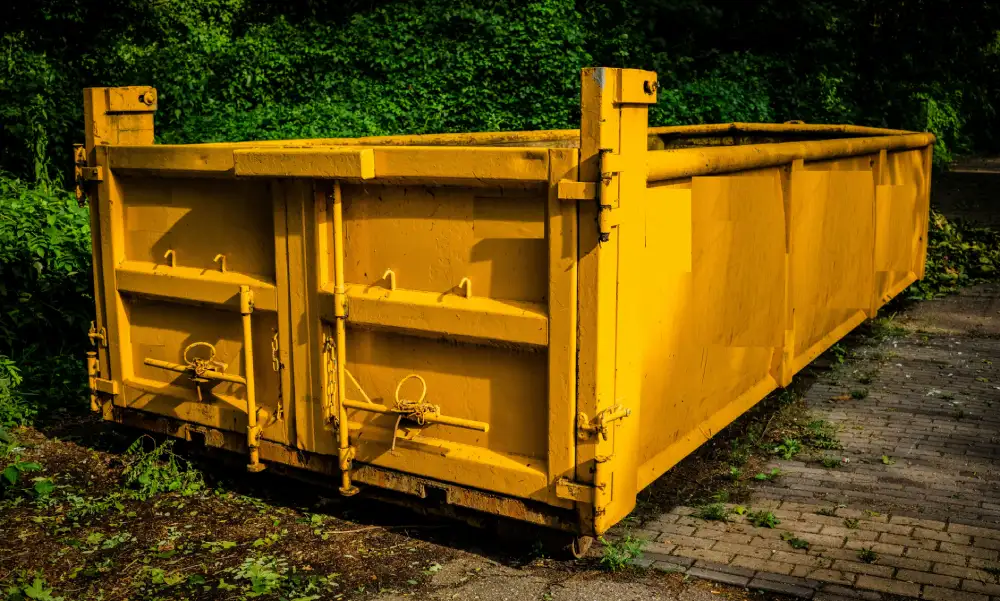
Photo by Haberdoedas on Unsplash
Table of Contents
You booked a container. What arrives is a three-axle truck thirty-five to thirty-seven feet long that needs more room to work than the container will occupy.
Most delivery problems come from that gap. but the dumpster truck cannot get into position to place it. This explains what the vehicle needs from your property, why a driver sometimes leaves without unloading, and what the rule about not filling above the rails means and does not mean.
What a Dumpster Truck Is, and How the Container Moves
The vehicle is a roll-off truck, written roll off truck or rolloff truck depending on who is writing. The name describes the method: the container is not lifted and set down but dragged up a tilting frame and later allowed to roll back off.
Two systems do this. A cable hoist uses a winch and a steel cable to pull the container up the inclined frame. A hooklift uses an articulated arm with a hook that engages a plate on the front of the container and hauls it aboard. A United States patent for roll-off hoist equipment, granted in 2013, describes both, and notes that containers carry rollers or slides at each end so they travel along rails on the truck bed rather than being carried.
New York City’s Sanitation Department specifies that hardware precisely for containers serviced in the city: eight-inch pipe rollers front and rear, four-inch nose rollers, a hook plate of inch-and-a-half stock, and a push plate of at least eighteen by sixty-six inches. It also requires that the container discharge its load by gravity, without jogging the vehicle and without anyone helping the material out.
That one design choice explains everything in the rest of this article. A crane sets a load down vertically. A roll-off truck has to back into line with the spot, tilt its frame, and slide a steel box of twenty-one to twenty-three feet off the back of itself.
What a Dumpster Truck Needs From Your Property
The container is not the problem. New York City’s specification caps container width at ninety-six inches and chassis length at twenty-three feet. The dumpster truck is a different matter.
The same department publishes vehicle data for a thirty-cubic-yard roll off dumpster truck: thirty-seven feet long, nine feet wide, three axles, a turning radius of forty feet, and a gross vehicle weight rating of eighty-five thousand pounds. Empty, it stands eleven feet tall. With a container aboard, it stands twelve feet six. When raised, the hoist rails reach twenty-five feet with a container aboard. The guide these figures come from has no date, which is worth knowing before you plan a gate around them.
That last figure appears on no delivery checklist. Headroom that is ample for the truck driving in can be nothing at all for the same truck once the frame goes up.
The University of North Carolina at Chapel Hill, which publishes design guidelines for the service vehicles that reach its buildings, last revised in January 2026, puts a roll-off truck at about thirty-four feet nine inches on its own — and at roughly fifty-two feet in total while a container is being picked up. The university asks for eighteen to twenty-four feet of overhead clearance, and notes the obvious condition that is easy to forget: the truck has to be able to make direct contact with the container.
Seattle Public Utilities states its access requirements as a checklist, updated in March 2024: a minimum backing distance of forty-five feet, a grade no steeper than fifteen percent, and fourteen feet of overhead clearance in every area the truck will travel. The figure that matters at a house is eighteen feet of overhead clearance where the container is not on a loading dock. The twelve-foot-wide approach applies to docks and compactors, not general access.
There is no national figure for how much room a roll-off delivery needs, and this article will not invent one. New York City requires a site-specific turning analysis rather than publishing a single number. Treat the figures above as the range that municipal fleets design around, and ask your hauler what its own trucks need.
Street Placement and When You Need a Permit
If there is no driveway or it is too short, the container goes in the street, and the dumpster truck works from the roadway. This is usually allowed and almost always requires a permit, with conditions varying sharply between cities.
Broomfield, Colorado, requires a container permit before a roll-off goes in the public right-of-way, triggered once the container stays more than twenty-four hours. Its July 2024 notice allows thirty days without an active building permit and one hundred eighty days with one, says the container should not exceed eight feet in width, and requires either a reflector at least four inches across on each side or a reflective traffic cone at least thirty-six inches tall.
Roseville, California, requires an encroachment permit for any container wider than six and a half feet and allows thirty days with one extension. It wants the name, telephone number and address of the container’s owner — the rental company, not you — displayed on at least two sides, with all four sides reflectorized.
Sauk Centre, Minnesota, under an ordinance amended in 2004, caps placement at ten days, requires reflectorized orange-on-white marking six inches high and a minimum of thirty-six inches long facing traffic, and bans containers from the right-of-way entirely between November 1 and April 1.
Three cities, three sets of rules, and not one figure that carries from one to the next. Roseville is the only one of the three that states in writing whose job the permit is, and it puts it on the property owner or a representative. Ask your own city before the truck is booked, not after.
Why a Driver Leaves Without the Container
Two families of reasons. They stop the truck at different stages of the rental.
Access is the obvious reason. Low branches, overhead utility lines, a car parked across the approach, a gate narrower than the truck — Seattle measures its own at ten feet one inch across the mirrors, North Carolina at eleven — soft or saturated ground, or a grade the truck cannot back down safely. Drivers refuse these because a dumpster truck stuck in a bad position cannot simply reverse out.
The load is the second, and it stops the truck on pickup day rather than delivery day. Some materials are regulated. Federal landfill rules bar bulk liquid waste from municipal landfills, with narrow exceptions, and define liquid waste by whether free liquid separates out under a standard test. Appliances containing refrigerant fall under the Clean Air Act, which prohibits knowingly releasing refrigerant during disposal and places the duty to recover it on whoever handles the appliance last; the Environmental Protection Agency set this out for local governments in April 2021.
Other materials are banned by state law rather than federal, and the list is different in every state. Oregon’s environmental agency, for instance, bars lead-acid batteries, used oil, large appliances, computers, monitors and televisions from its landfills, and tires with exceptions.
And a third group is refused by contract alone, with no law behind it. Tucson’s roll-off terms refuse paint, fuel tanks, batteries, appliances containing refrigerant and tires outright. Maryville, Missouri, puts blocks, brick, concrete, rock and dirt on the same refusal list as the hazardous items, and gives no reason for any of it.
Weight and the Fill Line
Four city agreements consulted for this article say some version of the same thing. Tucson: no material sticking out of the top or overhanging the sides. Las Cruces, New Mexico: items should not stick out above the top rail. Redlands, California: do not exceed the top perimeter of the container. Maryville: contents must not exceed the top or sides.
Three of the four pair the rule with a weight ceiling, and the ceilings are low. Tucson stops at twenty thousand pounds. Las Cruces will not service a container over twelve tons. Redlands, on rates effective January 2026, caps at ten tons and charges a hundred and thirteen dollars and fifty cents per ton above eight, and tells customers that heavy material should be loaded only fifteen to eighteen inches deep, end to end, and only in a ten-yard box. Maryville states the fill rule with no weight limit attached at all.
A dumpster truck is limited by what its axles may legally carry, not by what the hoist can drag. Seattle’s fleet specification for 2019 to 2029 gives its roll-off trucks a front axle rated at fourteen thousand pounds, a drive axle at thirty-four thousand, an empty weight of thirty-one thousand three hundred forty pounds, and a gross of fifty-six thousand. That leaves under twenty-five thousand pounds for the container and its contents, on a machine whose hoist can drag more. New York City rates its thirty-cubic-yard vehicle at eighty-five thousand pounds gross instead — the two cities specify different trucks for different work, and neither figure is national. Roll off trucks reach legal weight limits long before they run out of room. The federal figures people quote — twenty thousand pounds on a single axle, thirty-four thousand on a tandem, eighty thousand gross — come from federal regulation governing the Interstate System. The Federal Highway Administration states weight laws on the Interstate System are enforced as state laws. On the residential street outside your house, limits are set by your state, and in some states they are higher than federal numbers.
What this means in practice is simpler than the law behind it. The container has a volume. Your state has a weight limit. Concrete, soil, roofing shingles, and wet plaster reach the weight limit long before they fill the volume. This is why a ten-yard box exists and why your hauler would rather deliver two small containers than one large one you cannot legally have taken away.
A note on something you will read elsewhere: the fill line is often explained as a tarping requirement. Federal cargo rules require only that a load not leak, spill, blow, or fall from the vehicle; they do not prescribe a tarp. A few states require covering narrowly — Washington’s law, last amended in 2005, applies to dirt, sand, and gravel. No source consulted connects the top-rail rule to a covering mandate, so this guide does not make that claim.
None of the four cities gives a reason for the top-rail rule itself. All four cities state it as a flat condition of service and explain nothing. Treat it as what it is — a term of your contract, enforced on the spot by a driver who can decline the pickup — rather than a safety regulation you might argue around.
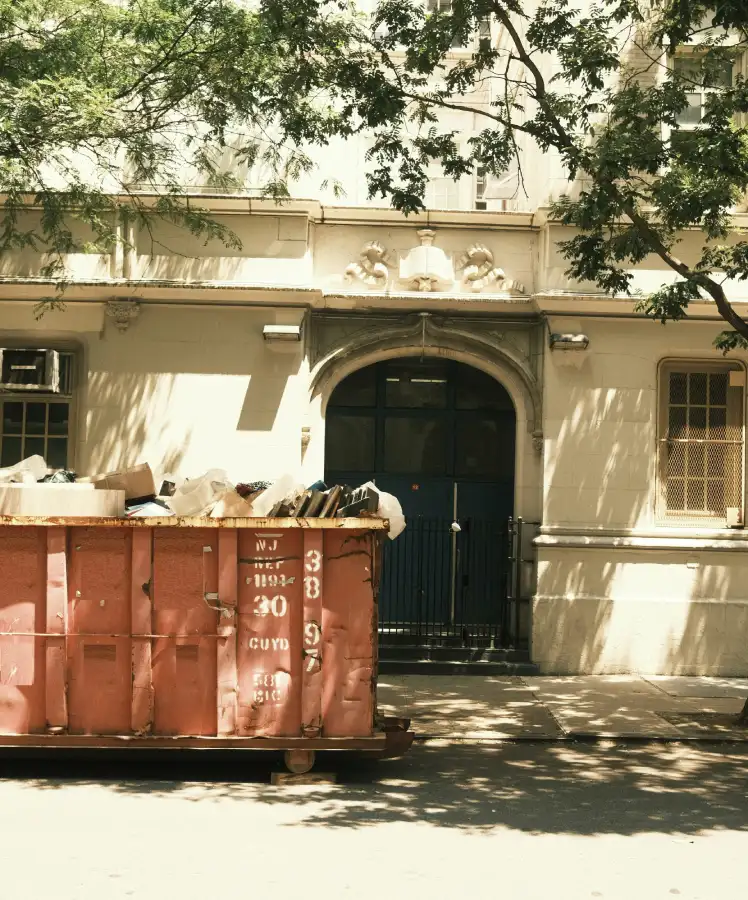
Photo by Danny Greenberg on Unsplash (modified)
Over the Rails Means a Wasted Trip
Four of the city agreements cited here say the same thing in different words: nothing above the top rail, nothing overhanging the sides. Three of them pair that rule with a weight ceiling — twenty thousand pounds in Tucson, twelve tons in Las Cruces, ten tons in Redlands — and none of the four explains why the rule exists.
What the Truck Does to a Driveway
A loaded dumpster truck concentrates tens of thousands of pounds onto a few square feet of tire contact on a surface built for passenger cars. Plywood or planking under the wheel path is the usual precaution, and asphalt in summer heat is the usual casualty.
The axle loading is on the record. Seattle rates the front axle of its roll-off trucks at fourteen thousand pounds and the drive axle at thirty-four thousand; those are the ratings the truck is loaded to, not the weight of the truck standing empty. What is not on the record is what those loads do to a residential slab. No government agency or peer-reviewed source consulted for this article studies roll-off trucks and residential driveways, and existing pavement research concerns highway design, which cannot be applied to driveways without a source making that connection.
What is on the record is where the risk lies, and one city names the truck explicitly. Columbia, Missouri, asks residents to sign a waiver stating the city is not responsible for damage to property from container placement “and/or the refuse truck driving on property to service container.” Maryville puts it more bluntly: damage from the container and truck is the customer’s responsibility, and the city is not responsible for driveways, grass, overhead wires, or septic tanks. Commercial haulers’ terms say the same in longer words. The risk is yours and contracted for in advance.
After the Pickup
The dumpster truck does not go to a yard. It goes to a scale.
Phoenix, on its 2024 rate schedule, bills residential roll-off service as a pull fee of one hundred sixty-five dollars plus a tonnage fee, with a gate rate of fifty-five dollars a ton for trash, and charges the pull fee again if the container is not serviced within ten days. Garrett County, Maryland, has charged sixty-two dollars fifty a ton for household and construction waste since October 2024, with a five-dollar minimum over the scales. Those scale tickets form the basis of your final invoice, which is why the number on it differs from your quote.
One thing you will hear about and that no public source documents: the single-visit exchange, in which the truck removes a full container and leaves an empty one in the same stop. Rental companies describe it; no municipality publishes anything about it. Ask yours directly rather than assuming.
Frequently Asked Questions
How long does a delivery take?
Minutes once the dumpster truck is in position. Getting into position is the variable and why haulers ask for a clear approach rather than a clear parking space.
Do I need to be there?
Not usually, provided you have marked the spot and the approach is clear. If the driver arrives and the position is blocked or unsafe, no one is there to move the obstacle, and the trip is wasted.
Can the truck back down a sloped driveway?
Seattle’s access standard is a grade of fifteen percent or less for a municipal fleet on a planned route. Anything steeper requires a conversation with your hauler, not an assumption.
What happens if the container is too heavy?
It stays where it is. The driver cannot legally move an overweight vehicle, so an overfilled container means a wasted trip, usually a second fee, and material you must remove by hand before the truck returns.
What license does the driver need?
Federal rules require a commercial driver’s license in Group B for any single vehicle rated at 26,001 pounds or more, which covers every roll-off truck in this article. A truck towing a trailer rated above ten thousand pounds falls into Group A instead.
Conclusion
A dumpster truck is a sliding machine, not a lifting one, and every rule that frustrates you follows from that. It needs a straight approach, overhead room for rails that rise to twenty-five feet with a container aboard, and a load light enough to be legal on your street.
Before the delivery, walk the route the truck has to take, look up as well as ahead, and find out what your city requires if the container goes in the road.See : 20 Yd Dumpster