
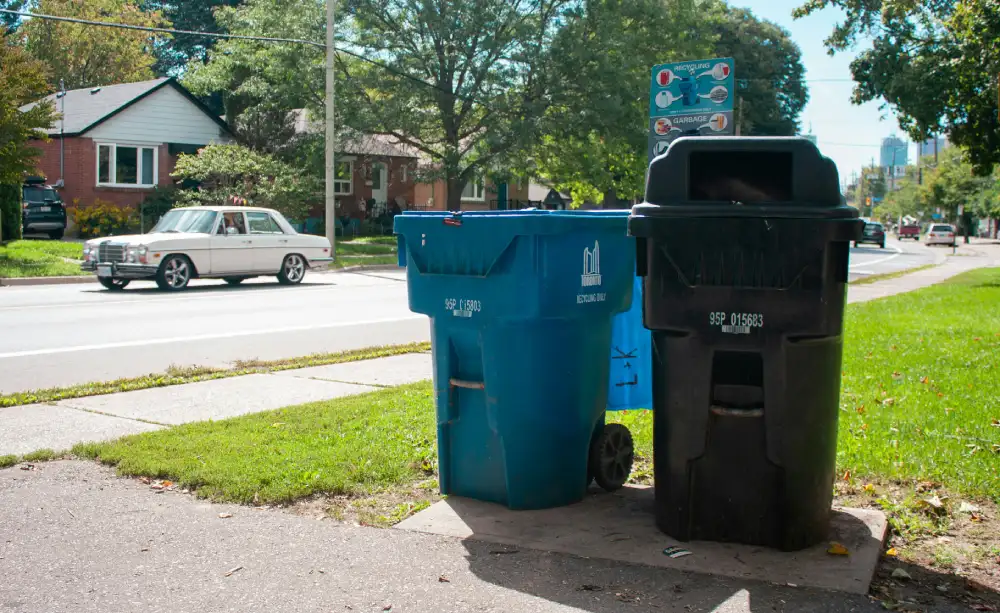
Photo by Leandro Younis on Unsplash
Table of Contents
Garbage Can Sizes: Capacity, Dimensions and Portability
Three things decide whether a container works: how much it holds, how much floor space it takes, and whether one person can move it when full. The number printed on the side answers only the first.
That number is also the one people remember and the least useful alone. A 65-gallon cart and a 95-gallon cart differ by about four and a half inches in height but roughly six in depth. The gap in what a city allows you to put in them is measured in dozens of pounds.
Capacity: What the Gallon Number Covers
Household containers are rated in gallons, describing the space inside the body, not the space you can comfortably fill. The lid, rim, and taper reduce several gallons from the nominal figure, which is why a bag that looks oversized for a can often turns out to fit.
The useful conversion is the kitchen bag. A standard tall kitchen bag holds 13 gallons, so a 65-gallon container should hold five and a 95-gallon container a little over seven. Published guidance from city programs is lower. One program tells residents that generally up to four kitchen bags fit a 65-gallon cart and six or more fit a 95-gallon cart. These are ceilings and floors rather than exact measurements, but both show that filled bags do not pack flat, so arithmetic overstates what fits.
That is the first thing to know about a rating. It is a ceiling, not a working capacity. Published trash bin sizes, garbage bin sizes, and waste bin sizes all describe the same ceiling, and the words are interchangeable. When a specification lists garbage container sizes or trash container sizes, the figure means the same. The size of garbage cans only becomes real once you decide if the contents will be bagged, loose, or compacted.
One convention is worth naming before the table. Specifications quote garbage can sizes gallons first and dimensions second, because capacity separates models within a product line. Dimensions vary between programs at the same capacity, so they are for checking space rather than shopping.
Garbage Can Sizes Chart
Dimensions below come from four municipal collection programs that publish specifications for the carts they distribute: Kettering, Ohio; Cedar Rapids, Iowa; Madison, Wisconsin; and Saint Paul, Minnesota. Where they differ, the full range appears. Weight limits come from a single program, Tulsa, Oklahoma, which publishes them for refuse carts specifically. This distinction matters because limits for recycling or yard waste in the same city can differ sharply.
The 25-, 30- and 40-gallon rows are retail labels rather than municipal cart sizes, which is why no collection program publishes their measurements.
Retail sizes: 25, 30 and 40 gallon
Sold in stores rather than distributed by a city. No collection program publishes their measurements, so dimensions have to come from the product itself.
25 gallon trash can
Dimensions not published by the programs consulted
No published weight limit
30 gal trash can
Dimensions not published by the programs consulted
No published weight limit
40 gallon trash can
Dimensions not published by the programs consulted
No published weight limit
Small carts: 32 and 35 gallon
The smallest wheeled carts a city will deliver. Both stay under the height of a kitchen counter.
32 gallon
36.75 × 19 × 26 in. (H × W × D)
80 lb refuse limit
35 gallon
36.75–39.1 × 19–20.2 × 23–26 in.
No published weight limit
Curbside carts: 60–65 and 95–96 gallon
The two capacities that cover most American households. Weight limits scale at a flat 2.5 pounds per gallon.
60–65 gallon
40.5–41.5 × 24–27 × 27–28.1 in.
160 lb at 64 gal · up to 4 kitchen bags
95–96 gallon
45–46 × 26–29 × 33.7–34.5 in.
240 lb at 96 gal · 6 or more kitchen bags
Two readings matter. First, trash can dimensions grow unevenly: between 65 and 95 gallons, height rises about four and a half inches while depth rises about six. Second, published weight limits scale exactly with volume — 80, 160, and 240 pounds across 32, 64, and 96 gallons equals 2.5 pounds per gallon at every size. Viewed this way, published garbage can sizes form a straight ladder on weight and a crooked one on shape.
What "Standard" Actually Means
There is a federal rule, and it is narrower than people assume. Title 40, Part 243 of the Code of Federal Regulations sets guidelines for storing residential solid waste. It requires containers emptied by hand not to exceed 75 pounds when filled, that they be sized and numbered to hold all waste a residence generates between collections, and that they conform to two industry standards. Its recommended practice adds a volume cap: no more than 35 gallons for a container emptied manually unless mounted on casters.
That rule does not fix a dimension, prescribe a shape, or tell a household which capacity to own. It sets a weight ceiling for manual handling and leaves the rest open.
A standard trash can size comes from three other conventions. The first is retail: bags are sold in a few capacities, and a container that does not match one is awkward to line. A standard garbage can size for a kitchen is quoted as 13 gallons because that matches the tall kitchen bag.
The second is collection equipment. ANSI Z245.60, the compatibility-dimensions standard for waste containers, sets dimensional requirements so a container built by one manufacturer can be handled by lifting equipment built by another. Two-wheeled residential carts fall inside its scope; containers that households empty by hand, and that no mechanical lift ever touches, fall outside it. The federal rule above incorporates this standard by reference, so conformance is not just a trade convention.
The third is municipal. Cities choose which capacities to stock, and the choice is not permanent. Madison has stopped distributing its 35-gallon cart and now offers only the 65 and 95, publishing the old dimensions so residents who still have one can measure it.
A standard trash bin size, a standard size garbage bin, and an average trash can size therefore describe what is common in a given market. Typical trash can sizes in one city are not typical in the next, and published trash can sizes from a retailer describe that retailer's range. The practical consequence is that garbage can sizes are worth comparing only within a market, and the only reliable source is your own program.
Shape and Footprint
Two containers of equal capacity can occupy very different floor space. A rating describes volume, which can be reached by going tall, wide, or deep.
A round body wastes the corners of any rectangular space. The geometry is exact: a circle inscribed in a square covers just under 79 percent of it, so a round container gives up about a fifth of its footprint. A square trash can of the same capacity fits flush against a wall or inside a cabinet and loses none of it.
Taper has a published rationale. The federal recommended practice specifies rounded edges and tapered sides with the larger diameter at the top so waste discharges by gravity when the container is tipped. That is why nearly every container, round or rectangular, is wider at the rim than at the base.
Published trash container dimensions reflect that rule: nearly every figure in the chart shows a body wider at the top than at the bottom. Curbside carts are rectangular and tapered, with a hinged lid and a lifting interface the truck engages. That rectangular geometry is now the dominant outdoor household form in the United States. All four programs cited above distribute rectangular carts. Older round metal containers, still described in some programs as trash barrel sizes, predate automated collection and lack any conforming interface.
A double bin trash unit, one body divided into two compartments, solves a different problem. It keeps recyclables separate without adding a second footprint but splits the available capacity between streams. For households that sort, that trade is often worth more than raw volume and is the main reason to look past capacity when comparing trash containers.
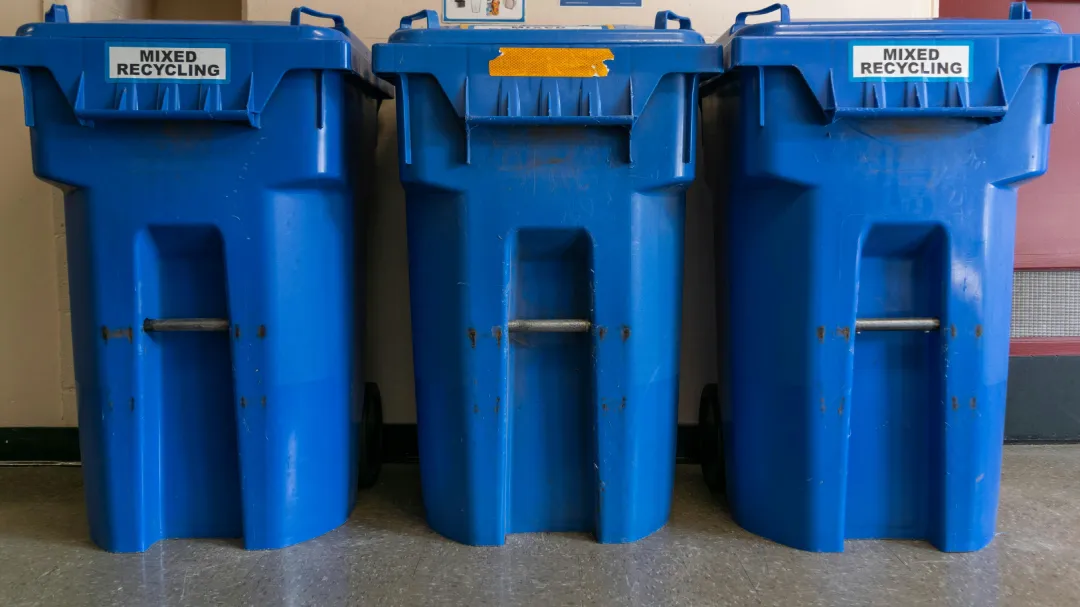
Photo by Albert Stoynov on Unsplash
Two bodies, twice the footprint
The federal recommended practice calls for tapered sides with the larger diameter at the top, so nearly every container is wider at the rim than at the base and two standing side by side take more width than their gallon ratings suggest. A double bin unit avoids that by dividing one body between two streams, at the cost of splitting the available capacity.
Portability: Wheels, Handles and Weight
This is where most sizing mistakes appear and where garbage can sizes stop being just a volume question.
The federal ceiling for a container emptied by hand is 75 pounds. A 96-gallon refuse cart may be loaded to 240 pounds. The difference is entirely the wheels: once a container rolls, the limit is set by what a truck can lift rather than what a person can carry.
Rolling is not effortless, and a two-wheeled cart is not a trolley. It stands upright on wheels at the back and must be tilted before moving, so the user carries part of the load while it is in motion. A rolling garbage can at 240 pounds is manageable on level concrete but difficult on a slope or gravel.
The hardware is standardized even though the bodies are not. A rolling trash bin, garbage cart, and trash cart with wheels all describe the same object: a tapered body on two wheels with a lifting interface the collection truck engages. Municipal procurement specifications routinely require trash carts to conform to the ANSI compatibility standard and carry a marking, which is why the interface geometry varies less between brands than the bodies do.
For containers without wheels, the accessory that solves this is a dolly. A trash can dolly is a wheeled base the can sits in permanently, and a garbage can dolly does the same for a larger body. Both convert a container that had to be dragged into one that rolls, which matters most for retail sizes above the 75-pound manual ceiling.
Two cart capacities cover most American households. The 65 gallon trash can and the 95 are the common pair, and the 60 gallon garbage can, the 65 gallon trash bin and a 65 gallon garbage can are the same class of container under different names.
Matching a Size to Your Household
Start from people and pickup frequency, not space available. Space tells you what fits; it does not tell you what you need.
Count bags for one full collection cycle. A household filling two or three kitchen bags between weekly pickups is served by a small cart. Four to six points at the 65. Consistently more than six means the 95 is the only single container that works. These thresholds come from the published bag guidance above, which is approximate.
Sorting changes the answer. A home that composts food waste and separates recyclables sends less residual waste to the curb, because the bulkiest fractions leave the stream, and that is often easier than persuading a city to swap a container.
One caution on going large: a full 95 is at the upper end of what one person can roll comfortably. Where a smaller cart clears a collection cycle, the smaller cart is the better choice. Check garbage can dimensions against the spot where the container will live before ordering a size up, because depth grows faster than height and a cart that clears a doorway may not clear a side passage.
Measured that way, the right garbage can sizes for a household are the smallest that empty cleanly in one cycle.
Set-Out Rules and Clearance
Most constraints on a container are local rather than physical. Programs set the hours a cart may be at the curb, how far it must sit from parked cars, mailboxes, and other carts, and which way it must face so the truck can engage it. Some impose fines for leaving a cart out past collection day.
Clearance is often forgotten. An automated truck needs room to extend an arm and lift, so a cart tucked under a low branch, behind a car, or against a fence may be skipped. For debris beyond what a cart can take, our guide to Dumpster Sizes covers the next tier.
For the order of preference that shapes those programs, with reduction and reuse first and disposal last, the Environmental Protection Agency’s (EPA) Waste Management Hierarchy sets out the framework cities design around.
Two Things This Guide Leaves Aside
Indoor containers are a different problem, driven by cabinet dimensions, materials and lid mechanisms rather than by collection equipment. They are covered in.
Keeping a container clean is its own subject, and a larger one than it looks: odor, liquid at the bottom and pests all follow from the same few habits.
Frequently Asked Questions
How many kitchen bags fit in a 65 gallon cart?
One collection program tells residents that, generally, up to four standard kitchen bags fit. Arithmetic suggests five, since a tall kitchen bag is 13 gallons, but filled bags do not pack flat and the published guidance reflects what actually goes in.
How much can a 95 gallon cart be loaded to?
One city publishes 240 pounds for a 96-gallon refuse cart, against 160 for a 64 and 80 for a 32 — a flat 2.5 pounds per gallon. Those are limits rather than typical loads, and limits published for recycling or yard waste carts in other cities are set differently.
Does a round or a square can take up less floor space?
A square body uses the space better. An inscribed circle covers just under 79 percent of its bounding square, so a round body gives up about a fifth of the footprint it occupies.
Can I ask my city for a smaller or larger cart
Usually yes, though the available sizes are the city's to set and can change. Madison, for instance, has discontinued its 35-gallon cart and now offers only two sizes.
Is there a limit on how heavy a container can be if it has no wheels?
Yes. Federal guidelines for residential waste storage put the ceiling at 75 pounds for a container emptied by hand, and recommend no more than 35 gallons of capacity unless the container is mounted on casters.
Conclusion
Treat the gallon figure as one of three specifications. Capacity decides whether a week of waste fits, shape decides whether the container fits the space, and weight decides whether you can move it on collection day. Comparing garbage can sizes on volume alone is how a container that looked right on paper ends up too heavy to roll to the curb.